
S2E12. Katrina Roberts on Why Comfort Comes Before Speaking Confidence
57 minutes
Summary
She’s back! Seven years after joining us in season one, voice and speech coach Katrina Roberts returns to challenge some of the conventional quick-wins-based wisdom about becoming a better speaker and presenter.
What if trying harder to look confident, remembering to gesture, and concentrating on your speaking technique is actually making you a worse communicator?
Katrina shares how being a better speaker starts with comfort before confidence. We explore why nerves show up in ways you might not recognise, why your body has such a powerful influence on your voice, and why learning to be present with your audience matters more than following a checklist of speaking rules.
We also get into a fascinating discussion about data storytelling, including why executives sometimes demand all the data, and whether we might have accidentally trained them to do exactly that.
What You’ll Learn
- Why trying too hard to be a good speaker can actually make you less effective
- Why Katrina teaches freedom and comfort before speaking techniques
- How your body, breathing and voice are connected
- A simple exercise involving your feet that can change how you feel and speak
- Why being present with your audience is more important than thinking about your own performance
- Why audiences deserve to have information made easy for them
- How analysts can accidentally train executives to demand more data
About Katrina Roberts
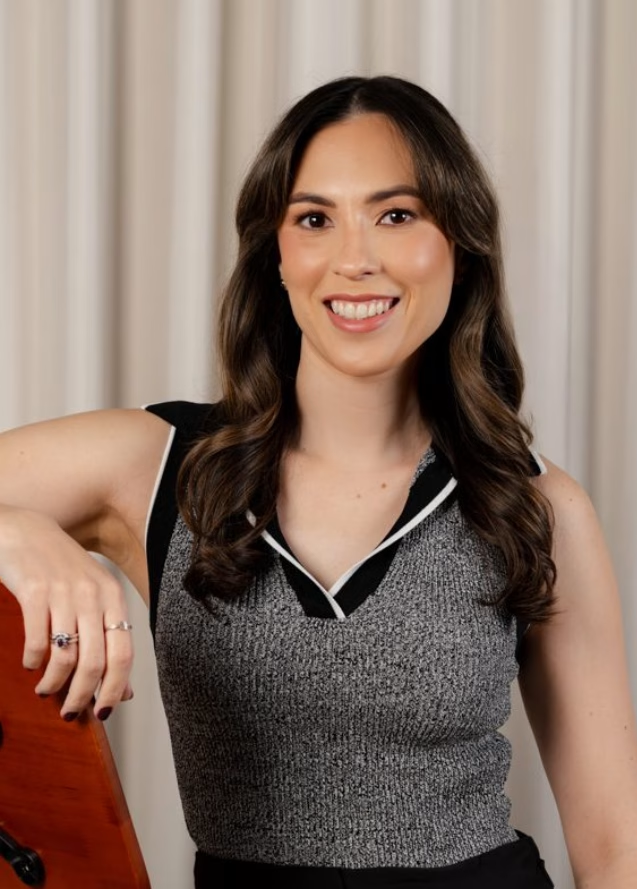
Katrina Roberts is a highly experienced voice and speech coach with over 15 years specialising in professional communicators, including actors, executives and professional speakers.
Through Simply Speech, Katrina helps people overcome speaking anxiety, develop their voice and communicate with greater comfort, confidence and presence. She also lectures in voice at JMC Academy in Brisbane and delivers her Speak to Serve program to organisations across Australia.
Worth Repeating
• “The last thing people want when they’re battling communication problems is more rules.”
• “Stop trying to be interesting.”
• “Audiences are inherently selfish, and they deserve to be.”
• “Communication is an act of service.”
Resources & Links
• Simply Speech: simplyspeech.com.au
• Patsy Rodenburg’s Presence
• Influential Analyst Academy: blueboxdatastorytelling.com.au/iaa
• Email us: podcast@presentationboss.com.au
• The Presentation Boss Podcast: https://www.presentationboss.com.au/podcast
• Kate on LinkedIn: https://www.linkedin.com/in/data-storytelling
• Thomas on LinkedIn: https://www.linkedin.com/in/data-storytelling-au
About The Presentation Boss Podcast
Presentation skills for analysts, technical professionals and anyone whose ideas deserve to be taken seriously.
Every episode is designed to help you communicate complex ideas simply, influence decisions, and build confidence while presenting your work.
From data storytelling and slide design to strategic communication and presentation delivery, we break down what great communicators do and show you how to apply it.
Want To Become A More Influential Analyst?
The Influential Analyst Academy is our professional development community for analysts and technical professionals who want to communicate their thinking more effectively, have greater influence and advance their careers.
Transcript
Thomas: It is episode 12 of season two of the Presentation Boss Podcast, and today we have another guest expert interview, which is a little bit exciting, uh, that we have our first repeat guest all the way back from episode eight the first season, which was in May of 2019. So Kate, tell us a little bit about, uh, our guest today.
Kate: Okay, we have Katrina Roberts, and, um, she’s a voice and speech coach. She’s also here in Brisbane, and it was actually one of our more popular episodes. Always did really well because what she talks about, she approaches speech from a, a different way to a lot of speech coaches. I really like her approach.
Um, and she’s just so easy to listen to. I find her very calming. It’s just, everything just, uh, the conversation flows so nicely with her. Um, and of course, it was a great conversation. I, I think that, again, this one’s going to do well ’cause she’s just good
Thomas: We do like us a bit of Katrina. Um, before we jump into hearing a bit more about what she has to say, um, look, if you’re a technical professional or somebody who’s brilliant at the technical and data side of your job but do wanna get a bit better at everything that follows on from the analysis specifically, uh, or particularly I should say when it comes to the communication piece, the speaking piece like we’ll talk to Katrina about, and being able to influence decisions, uh, it could be a good idea for you to check out the online community and academy that Kate and I run.
It’s called the Influential Analyst Academy. Every month we work on a very specific skill. We have a number of live calls where you can get real time with Kate and I, show us what you’re working on, get some real feedback and, uh, you know, working with other people who are working on similar skills, and it’s completely outside the high stakes of your nine-to-five job, right?
So, uh, I encourage you, come and check it out. If you like this episode, if you like the work we do, I’ll put a link down in the show notes for you to have a look at the Influential Analyst Academy. Enough about that. Kate, uh, let’s hear Katrina’s official fancy bio
Kate: Katrina Roberts is a qualified and highly experienced voice and speech coach with over 15 years specializing in the training of professional communicators, including actors, executives, and professional speakers.
She holds several post-graduate qualifications in voice studies, speech training, public speaking, and teaching. Since launching Simply Speech in 2019, Katrina has successfully coached thousands of communicators from business owners battling severe public speaking anxiety to government officials influencing on the world stage.
Alongside her one-on-one work, Katrina is a voice lecturer at JMC Academy in Brisbane and brings her Speak to Serve program to corporate and not-for-profit groups across Australia. Katrina is also a respected adjudicator of national speech, drama, and acting festivals and a former award-winning toastmaster.
She believes that comfort creates confidence, that speakers need to avoid affectation and prioritize She believes that comfort creates confidence, that speakers need to avoid affectation and prioritize presence in communication if they are to truly connect with and influence others. No cheap tricks, no fake it till you make it, just transformative and evidence-based voice and speech training that creates quality outcomes while empowering speakers to find, release, and trust their voice.
Thomas: I’m so excited for you to hear our conversation with Katrina Roberts Welcome Katrina Roberts to the podcast
Katrina Roberts: Thank you. Such a pleasure to be here. Very happy to be here
Thomas: I should, I should actually say welcome back, ’cause I was looking it up. You were one of our very first guests on the, the… So season one of the podcast, uh, episode eight, and that was back in May 2019. I think you’re our f- our first repeat guest
Katrina Roberts: Really? Oh,
Kate: Hmm?
Katrina Roberts: is, that’s a lot of pressure. Jesus. Great. Love that. That’s good to know
Thomas: Uh, but obviously your, your work is still relevant and, uh, y- look, before we get into it, we’ve heard your official bio. can you tell us about Katrina Roberts when you’re not at work?
Katrina Roberts: When am I not at work is probably the more, the more boring sentiment to express. Look, at the moment, in the best way, my life in and out of work is always revolving around speaking, communication, acting. I just love what I do. It’s, in the way that it doesn’t feel like work, so even my life outside of work just feels like more of the same.
So I love working with my actors. I love being able to, in my own time, read, read plays, work on acting skills. Again, it’s all sort of an extension of the same thing. I otherwise am very boring. I have no hobbies beyond talking, just talking, just communicating.
I c- I, I don’t sport. I don’t throw balls. I just love to talk, and so every inch of space in my calendar is just filled with this as either a job or a hobby
Thomas: Amazing. Well, I mean, look, tell, tell us then about your work. Who do you help? How’d you get involved in voice and communication?
Katrina Roberts: So I’m working primarily with professional communicators, and that of course encompasses so many people. That might be professional keynote speakers, that might be leaders and C-suite executives. A lot of the time too I’m working with actors and training them for film and theater applications. So anyone who is paid to open their mouth is primarily who I will be working with.
I also do a lot of work with people though who are struggling with the, the premise of opening their mouth in front of people, which is not something to take lightly. It’s quite difficult, as we can all appreciate. And if people are struggling with quite severe public speaking anxiety or symptoms of vocal loss that are attributed to that, that’s also where I would step in.
So I get to work with a whole range of experience levels. But truly my, my bread and butter and the people who I’m most, m- not to say my favorite, but the people who I really enjoy working with are the professional communicators, ’cause I appreciate the stress and the pressure that they’re under
Kate: So when someone comes to you, I assume they come to you with like, “I need help with this.” Um, and is- do you find that there is any sort of difference between what they think that they need help with and what they actually need help with?
Katrina Roberts: Great question. All the time, and I was even thinking about this the other day talking to a client who asked a similar question for a very different reason. And ultimately, what people are coming to me with are all sorts of things they need to work on. They’ve been told they need to gesture more, they’ve been told that when they present at meetings, no one understands what they’re trying to get across.
They’re talking too fast, they’re talking too loud, their voice is annoying. They have all of these preconceived ideas of what they can’t do, and when it comes down to it, the vast majority of people will really be working on one or two things. The first being nervous system dysregulation, so in short, nerves.
And a lot of people don’t even realize that what they’re experiencing is symptoms of being nervous. They think, “Okay, I’m nervous, so my knees would be shaking. I’d be sweating up a storm. I would be chattering in my teeth.” That picture of nervousness is not what it usually presents at, especially not if you’re in a high level already.
You didn’t get to be a middle manager or a C-suite because you’re still shaking at the knees. How nervousness presents for you is a lack of things, is a barrier. It’s something not going right, so gestures suddenly not working, eye contact being difficult, rushing, not communicating at your audience’s level.
A lot of that can come from people not being present enough in the room, not being present enough in their body, not listening to themselves, and without that awareness and ability to be in their body and in the room, all of those things become impossible because the body and the voice is only ever gonna reflect what’s actually going on.
And if what’s actually going on is distress, whether we wish to acknowledge it or not, you’re only ever gonna communicate that. There’s a flat affect, there’s a wooden-ness, there’s something not right, and usually their managers and the people who often push them to vo- voice training don’t even know what it is, and that’s where I come in to help them solve that and go, “I don’t know what it is about X, but they just need some help.
Can you figure out what it is?” And it’s probably, for the most part, gonna be they’re really, really nervous, and that’s a huge journey. The second element of that would be as part of being nervous, they’re not very present and so that’s that being in the room piece, but it’s so much more than that. That energy that people want when they walk into a room and feel like everyone looks at them.
That sense that if you are speaking, people lean in and listen to you. That’s not to do with having the right words as much as it is having the right energy, and so I work a lot on people’s energy, their presence, which again is attached to how nervous they are. So really it all starts there, and if I can start working through that with them, suddenly the whole world of communication skills opens up in a way that’s sustainable.
And I know that they’re not gonna have to come back to see me in a year because it’s reset again, and they h- they still haven’t figured it out.
Kate: So how do you teach then, like, um, technique without being prescriptive? I’m thinking here, like, um, I remember when I was learning to speak in front of an audience, and there was, you know, you’ve got to move your hands like this, you’ve got to pauses. And I found it was like a separate algorithm that I had to run beside, like, the speaking. So how do you, like, merge those things? Do, do you know what I’m saying there?
Katrina Roberts: Totally. And that’s so often the gap, isn’t it? It’s that there’s all… To fix the problem, we now have new mini problems that we have to solve,
Kate: Yeah
Katrina Roberts: “Okay, I wanna be better, so I’ve got to tick these boxes.” But in doing that, yeah, it separates you from the actual solve. So how we work on it is I’m really focused on building muscle memory.
So I very rarely, in fact, I’m thinking across the board of a whole journey with someone, even at the tail end, I’m very rarely talking about those things at all. Same with my actors, and in the acting world you would never be talking about, “Oh, you need to pause a bit longer there. You need to do this, that or the other.”
It’s always about how do we create meaning for the audience, and that can be in a variety of ways. How can we connect more deeply to other people? How can we feel better in ourselves? And that’s all muscle memory. It’s physiological primarily before it’s psychological. And so at that bottom-up approach of if in a training process we can get the body working first, we can get the nervous system on board, no thinking required, nothing to do at all with preconceived ideas about getting it right, I just want you to feel better.
If we can program that into your body, then we can add a little bit of that structure. But we do it in a really exploratory and curiosity-driven way. I have no care in the world for rules about pause, pitch, pace. Yeah, these things are important, and yes, we will work on them in exercise. But I’m not trying to get them to achieve anything.
What I’m actually getting them to try to achieve is flexibility. I wanna see that they can go fast and slow. I wanna see that they can do both. I wanna see that they can pause long and pause short, and I importantly wanna see that they can make that choice. That’s what I really, really care about. Not that they are going, “Well, someone said I had to speak at this many words per minute, and if I pause for three seconds, people will believe me.
I will be authoritative.” ‘Cause that’s just not how that works. It’s never been how that works. And so it’s really important as part of that process that we’re just encoding it into their body, getting them to experience what we want them to experience. And then if I can get them to do that, they can start assessing for themselves what they, what their criteria should be, and I can shape that a bit more, but keep it loose enough that they feel they’ve got freedom.
‘Cause the last thing people want when they’re battling communication problems is more rules. And so if I can free them of that sense of you have to have it right, that’s already gifted them freedom, and that’s really all I want.
Kate: Yeah. Um, because I, I guess like the reason I ask it again, it’s that, that sense of freedom is what you’re chasing, and I feel like I kind of have that eventually, but that took a lot of time because, um, like it reminded me ’cause you talked about presence and like being in the room, being there when you’re speaking.
Katrina Roberts: Mm-hmm.
Kate: But when I first learned and was first practicing speaking,
Katrina Roberts: Yeah
Kate: it was like that presence got worse because I was thinking about how I was speaking while trying to better speaking. It was like this, like its own spiral
Katrina Roberts: Yes, and I’m sure that was a bit probably more painful than it needed to be in that sense. Not that you didn’t get to the result, but it probably arguably, if you were to be able to compare yourself in a different context, that probably would’ve taken you longer to get to where you needed to go. Whereas what I’ve found just through experience really, but also looking at the way that we train actors and we coach actors and taking those principles into not a dissimilar, uh, venture, it’s all about get freedom first, then structure.
So it’s open your world, open the doors, explore without judgment, and then structure, and generally that’s faster as well. If you can get someone freedom first, they don’t have to work really hard and hopefully get freedom at the end. But both will work, so ultimately as long as it works, it works, right?
But my goal is I want it to work fast, well, permanently, and efficiently, and generally structure last is the way.
Kate: Yeah, good. I wish that I’d gone that route because I remember being, um, in a work meeting and I was like, I was trying really hard like, you know, start using these skills, and afterwards, um, it was a manager, not my manager, but someone was like, “I can see you’re working really hard on your speaking.”
Katrina Roberts: Yeah
Kate: “Oh, you can see that I’m working really hard.
That’s
Katrina Roberts: Thank you for that horrifying feedback. Yeah. Thank you. That’s the worst thing you could have possibly said to me. Yeah. No, that’s so true
Kate: “Well done. You’re practicing. You’re learning.” But the way that it came across, I was like, “Ah, so I look, I clearly look like I’m in pain.”
Katrina Roberts: Well, right. It’s still because there’s still no freedom, and ag- yeah, again, you’ll get there at the end, and generally people will. But… And if we think about other skills, that’s often how it works, right? You know, if you try, if you try really, really, really, really hard, and you work really hard, at the end, you’ll be able to relax.
But communication, just even in terms of your anatomy, your physiology, the psychology of you as a human being, that’s not how you work. Your nervous system and your whole body has… And this is just not even s- this isn’t a bias. This is the truth. If you genuinely feel safe, okay, comfortable, everything is possible.
Suddenly it’s easy to acquire a skill. It’s so easy for me to, for example, have a conversation with someone about gesture after that. It’s so easy. I can do it in one session. I can teach someone how to use pace in half a session if they have freedom first. And then what the feedback hopefully is in that example is instead of, “Oh, you’re working really, really hard,” the feedback can be, “You seemed really comfortable.”
And it might, they, their gestures might still have been all over the shop. They might have still been pacing a little. They might have still been… But their managers will time and time again feedback, “You looked so much more comfortable, so much more comfortable,” even if it wasn’t perfect and pretty yet, and it wasn’t structured, and I think that just goes to show that at the end of the day, your audiences, our audiences, will always value a speaker’s comfort, regulation, what we feel is confidence, over pretty and perfect.
And so that’s where I wanna begin.
Thomas: Yeah, I love that. Trying to not be perfect, but just be comfortable. Um, and I’m, I’m curious here in, in this corporate space where you’ve got somebody who… I know plenty of people who listen to the podcast are most comfortable dealing with a spreadsheet rather than in front of an audience. How, what’s, what’s…
You know, they stand in front of an audience and the nervousness just hemorrhages out of them. How do we move towards being safe, comfy, having that freedom when it’s just semi-impossible feeling right now?
Katrina Roberts: Oh, totally. The solution is always firstly in the body. So what I would wanna do with someone like that immediately, and this is pretty much everyone who I’d work with for the first time, our first session is about I’m trying to get them to feel what’s happening in their body. And not in a woo-woo spiritual way necessarily, but a lot of people, if I ask, for example, in that first session, they’re in that space, they’re hemorrhaging anxiety, and I ask them, “Can you tell me what your feet are doing?”
They, they know the question. They are try- and they, they look and it doesn’t help, and they are genuinely trying to answer it, but there’s… They, they physically can’t. They actually have no idea what is happening inside their own body, which arguably they would know about more than me ’cause I’m not in there.
And so that’s always a revelation to them because I’ll ask them the most simple questions in the world. “What are your feet doing? Can you describe…” And I’ll give them really c- really clear cues. “Can you describe how the weight is in your feet? Are you putting more weight on the left or the right? Are you tapping one foot more than the other?”
Just asking for specificity. “Are you locking your knees? Do you feel there’s tension e- in this area? Is there pain in this area?” And it takes them a little bit. They, again, they understand exactly what I’m asking of them, but the instruction from brain to body, that pathway is dusty, and they don’t know how to feel.
And as spiritual and deep as that is, it is that deep. If you can’t tell what’s happening in your own body, how the heck are you controlling my body, my experience, me in that room? You don’t even know what you’re doing. And if you don’t know what you’re doing, not really, not really in a sense of feeling it impulsively and organically, you’ve got no chance of genuinely making a choice or j- or shifting something.
It’s always a happenstance, it’s a coincidence, or it’s a panic button, “Oh, I probably should gesture,” and then something happens. And but it’s, it, it doesn’t add anything. It sometimes makes it worse. We’re like, “You know what? I’d rather you didn’t. I’d rather you do nothing rather than add that funny thing that you thought you had to do.”
So that’s what I wanna begin with. And it doesn’t take long. Once, once you open up that neural pathway again to go, “Oh, what am I doing in this present moment?” you’ve already unlocked the primary base of their communication skill, which is being able to, in the moment, be present, assess, gauge, and therefore change.
And if they can do that, then I can teach them a skill. But if they can’t do that, I will sometimes spend, especially for people like you’re describing, you know, one or two… which isn’t forever, but, you know, one or two hours or sessions just on that until they almost look at me condescending and they’re like, “Are you really gonna ask me what my knees are doing again?”
I need them at that point, that they can walk in and go, “Don’t even ask me what I’m doing with my body. My knees are doing this. My feet are doing that. My belly’s doing that. I know you’re gonna say that about my shoulders. I already know.” If I can get them there- We’re, we’re all right. But that’s usually the solve because they suddenly go at the end of the session, “I feel a lot calmer than when I walked in.”
And it’s not because I’ve done any magic or it’s not my fantastic personality, it’s because they have been in their body. And when you’re in your body, suddenly the, the regulation comes through in waves and you realise, “Oh, now that I’ve noticed stuff, I’m not holding on so tight. Now that I’ve noticed stuff, I’ve actually changed.”
And I haven’t even had to tell them to change ’cause you know instinctively what it should feel like, and you know that pain and stress is not good. So it doesn’t take much, just look. And if I can get an analyst or someone who is really data-driven and is totally out of place in front of an audience to do that, we’re good as gold.
We can do all sorts of things
Thomas: Mm. This takes a, a bit of, a bit of time, a bit of consciousness and, you know, and we, a- as, as Kate alluded to here, you can kind of tell when somebody is just trying to look confident or work on it rather than being connected to what they’re saying. You know,
Katrina Roberts: Totally
Thomas: that I sort of, I get here is when we’re, we’re trying to be a, quote-unquote, “better presenter”, we end up looking less natural, less effective.
You can see that somebody’s trying to be themselves, right?
Katrina Roberts: That’s it. And we call it in the acting world, and therefore I bastardize the phrase for my own clients, the phrase is, or the advice is, stop trying to be interesting. The moment you try to be interesting or the moment you try to be good is the moment you’ve lost the game already, because that’s not actually the game you’re playing.
If you’re playing the game of am I good? Am I enough? Am I, am I doing a good job? Do I get a sticker? If you’re gamifying communication like that in the moment of communication, I’m not saying there’s not value to that elsewhere, but in the moment, if that’s your concern, you can’t also be concerned about me.
You can’t also be with me as in the audience, figuring me out, sussing me out, ensuring my experience. You can’t be doing those two things at once. It’s either me, me, me or them, them, them. And if you’re present and engaged with your audience, it’s nothing about you. It’s all about them. And that’s again, a strategy, not just a philosophy, but a strategy to get you out of your head.
You’ve gotta get into theirs. We’ve gotta be here. If you’re still here, you can’t– we can’t help that. But if you’re suddenly worried about me or what I’m doing, and I have all sorts of crazy exercise I do to help people do that, then suddenly you might realize, oh wow, I’m, I’m feeling a lot better. Yeah, ’cause you’re not thinking about yourself.
It’s not about you, it’s about me. And if you get with me, it’s easier. Please go. Yeah.
Kate: Mm. I was gonna say, you know what it reminds me of is, um, my seven-year-old is, he’s a really funny kid, sometimes I’ll say like, “You’re so funny.” And then he’s like, “Oh, I’m funny?” And then he will try to be funny,
Katrina Roberts: Oh, and it’s awful, isn’t it?
Kate: It’s awful. I’m like, “No, go back. Go back to just doing it naturally.”
So I think it’s, it’s… And you s- honestly, you see adults do it as well, where they
Katrina Roberts: Totally
Kate: laugh and then they like try to be funny from
Katrina Roberts: Oh.
Kate: it’s like, oh, stop it. Like, just, yeah. Um, it’s
Katrina Roberts: Mm-hmm. That’s it
Kate: equivalent of that
Katrina Roberts: Totally is. Spot on. That’s a great example. Which seems, is so counterintuitive, isn’t it? You think, “Okay, well to improve I need to be really introspective.” And that’s not untrue. You know, I need to really think about me. Of course, of course. I mean, yes. But actually, there’s dualities in everything.
Actually, the solve is not about you. To be better you, you gotta be more in- more present, more engaged and with us, and then suddenly you won’t worry about if you’re funny or good, you just will be. Which is annoying, because you wish that if you just focused harder it would be better. But that’s just not how it works, unfortunately
Kate: It comes back to the like, “I see you’re trying really hard here.”
Katrina Roberts: Yeah, exactly. Exactly. The cycle continues. Exactly right
Thomas: We see necessarily communication has to be audience-centric. Like, it’s not about what’s said. We could just read the slide if that was the case, but, like, what the
Katrina Roberts: Exactly.
Thomas: hears. I don’t know how many, I don’t know how many workshops we’ve run where we say, like, “People are not here to judge how good or awful you are at speaking.
They’re just here for a message. What the heck can they get out of you?” Like, that’s… They’re not watching you that hard, really
Katrina Roberts: They really aren’t. They really aren’t, and if they are, it’s for a moment, and if they are for longer than a moment, they’re not the audience that you should care about anyway. But truly, if you put yourself in their sh- in y- if, when you are an audience, you just don’t care. You want … Yeah, exactly. Audiences
I tell my clients, “Audiences are inherently selfish, and they deserve to be.” You deserve to go to a movie with a bucket of popcorn and not work hard. You deserve to sit back, relax, and have an analyst package information in a way that it is so accessible, so easy to digest, you don’t even have to try. You deserve that in the audience.
You don’t deserve to do the work for them. And so if we can g- help them do that, then it means that when it’s your turn to sit down, you can do the same. You can benefit from good communication and be as, as lazy and relaxed as you want to and deserve to be. We don’t need to work harder. We need to work less in the audience.
Thomas: I think I’m gonna steal that, that an audience deserves to be lazy. Like, um, we say an audience is often sitting there just thinking to themselves, “So what?” Like,
Katrina Roberts: Exactly.
Thomas: this-
Katrina Roberts: is it relevant to me? Yep,
Thomas: “Hmm,
Katrina Roberts: and if you spoon feed them, yeah, why am I here again? Could- why is this not an email? Well, the… yeah, these… and in both our worlds, this is exactly the conversations that happen
Thomas: Mm.
Katrina Roberts: every single time in a corporate
Thomas: Every time.
Katrina Roberts: Every time. But yeah, we deserved, you know, they deserve spoon feeding.
Why not? Why not? I tell… I really get my clients to empathize with the people they’re talking to ’cause it’s har- let’s admit, it’s hard to empathize with your higher-ups sometimes. But I really get them to put themselves in their shoes and go, “I want you to imagine their calendar. I want you to imagine that this is the third meeting on…
They’ve had two Teams meetings in the morning. They’ve been up till 10:00 PM the night before. Their wife’s very unhappy with them because they’re not spending time with them, and they’re coming to work already stressed, dysregulated. Their breath is high. They’re having a terrible time. You know how you feel when you’re in front of people and anxious?
That’s how they feel 24/7. So, do you really wanna make them more frustrated and make them feel like they’re dropping the ball more? Or could you make them feel like they’re having a better time? Could you make that one hour of their day more pleasant for them in some way, just some small way, by packaging information better?
Make their job easier, and they will promote you, laud you, hire you again and again and again.” The person who can make that exec feel better is the person they will pay through the nose for ’cause that’s all they want, relief and ease, and they deserve it as well.
Thomas: Yeah. Make it fast and easy for sure
Katrina Roberts: Mm-hmm
Kate: to know that it’s not necessarily about you, but that’s easier said than done. So
Thomas: Mm-hmm.
Kate: comes to you, and you know, I, I know, um, when we very first started this podcast years ago, listening back, it took me so long to be able to listen back to my own voice. So if someone comes to you and says, “I do not like the way that I speak,” w- how do you help them with that? What do you, what would you wish they understood?
Katrina Roberts: Great question So knowing that it’s all from that same base of your voice is only a reflection of what your nervous system is doing, that’s very much where I begin on that conversation about the voice itself. And when people don’t like the sound of their voice, I tell them what they’re really listening to is what your voice is trying to pick up and communicate about your body.
Because we always forget that our body and our voice is an instrument, right? And so, yeah, your voice is here, but that’s kind of the equivalent of the guitar strings. On their own, the guitar strings aren’t that interesting. They don’t really offer that much in terms of the final production of the sound.
What makes the guitar sound as good or as great as it could sound is the body of the guitar, how it’s shaped, whether there’s a slight imperfection in the wood. If the guitar is shaped well, the voice will sound good. That’s just an undeniable, indisputable anatomical fact. So we start there, and I tell them, “Okay, so if you wanna therefore change what the strings are doing and therefore the sound you produce, we’ve got to then change what the strings, or the voice in this example, is picking up.”
If you are tense in the body, A, for your comfort we need to work on it, but B, tension will dampen sound. And so if you are tense in the shoulders, especially anything up here, tense in the shoulders, holding a smile on, clamping your jaw shut, if you’re gonna do any of these things, it’s gonna affect the sound of your voice.
And so if you wanna change the sound of your voice, you have to start changing you. That’s just, you can’t get around that. You’ve gotta work on shoulder tension. You’ve gotta work on breathing technique. Same principle of any woodwind instrument specifically. If you don’t breathe sufficient air into a, a very expensive flute, it’s still gonna sound like a cheap flute, and you’re still not gonna like the sound of it.
And you’ll go, “But I bought the best flute in the world.” Because how you play that flute is the flute, is the production of the sound you want. So then if you wanna be able to fix it, you’ve also gotta be able to work on your breath and how you use your breath to power your voice. And I give them the challenge that if you work on those two things for me, so with my help of course, if I help you get to the point that you’re not nervous, ’cause they do think it’s unrelated, but I have to leave them with the hypothesis.
If you can prove to me you’re not nervous, if, and physically, ’cause I know, if you can then prove to me that your body is tension-free, stable, a nice shaped guitar with nothing stuffed inside it or making it v- vibrate differently, and if you can play that guitar, or to use the woodwind analogy, blow air through it well, then tell me if you still don’t like the sound of your voice.
And they’ll go, “Hmm. All right.” Skeptical, but they’ll do it. They’ll do it. And then we always get to that point they’ve done those three things, manage the nerves, address the body tensions, and use their breath properly, and every single time, I’ve never had a client turn around and go, “You lied. You lied.
That’s not the truth. I needed to do another thing. I had to do s- humming and stuff. They go, “Oh, I sound- whoa, that’s- whoa, that sounds way better.” And I go, “I know, because you did things in the right order. You figured out the instrument, not tried to make your guitar sound like someone else’s guitar. You actually figured out your own way through.”
And then from there we do a little bit of zhushing around and refining of it, but they already are less nasal, less brash. These are the common things they would be complaining about. Less nasal, less brash, less Australian, less, uh, less mumbly, speaking slower, pausing more. We haven’t even talked about any of those things, and they bring them up and go, “I’m, I’m, I’m not talking as fast anymore.”
Because all of these things are symptoms of root causes that they’ve just addressed. And so that’s my challenge to them if they come to me with that kind of appropriate skepticism or curiosity.
Kate: Yeah. Yeah. Okay. So what is then if we, if we take that, um, what is the very first step with people like that? What is the very first step that someone can take to be more aware of their body and therefore their voice?
Katrina Roberts: Great question. Funnily enough, it’s their feet. I know that’s so annoying. Um, but it is, it is. It’s always the same answer.
Kate: Yeah
Katrina Roberts: It is, it is. And but in this sort of exercise, so not just their feet, but we start with the feet because that’s where your body starts, as in that’s how you contact the ground, that’s how gravity affects you first.
How you stabilize your feet will change, to use a building analogy, your foundation changes your penthouse. And so if you wanna work on your penthouse, you can’t have a crappy foundation. You gotta figure out your feet. It’s not… Y- you can’t pretend they’re not related. And I prove that to them. So this is the exercise I get them to do to answer that point specifically.
I get them to deliberately do things wrong. So I’ll tell them, “Okay, I want you to…” For example, say they’re standing. “Okay, I want you to deliberately lean on one foot, lift one foot off the floor, tap it around like you’re really anxious.” And they’ll go, “Got it, easy.” And then I ask them, “Okay, now tell me what’s happening with your breathing.”
And they’ll fig- they’ll think about it, and they’ll go, “Uh, what’s happening to my breathing? Well, it’s kind of…” And they’ll usually point. They’ll instinctively point. They’ll go, “Mm.” “I can’t really feel it actually. I, is it, it’s kind of, uh, kind of here?” And they look at me skeptical like, “That’s the wrong answer.”
I’m like, “No, no, that’s… You can absolutely experience your breath here. Of course you can. Just ’cause literally your breath’s not there doesn’t mean you don’t perceive it that way. So yeah, sure. Okay, your breath’s here.” And then I say, “Okay, well, what if you stood like this?” And I’ll usually ask them about a sport they’ve played.
Doesn’t work on me ’cause never played a sport, but it usually works on most people. So, like, any sport ever requires stability in the feet. Any sport ever. You can’t lean on your heels for most sports, not well anyway. You’ve got to be on the front of your feet. You’ve gotta keep the weight balanced on both feet.
You’ve gotta be structured properly. And I get them to stand like they’re playing that sport, and then I ask them, “Okay, where’s your breath now? What’s your breath doing now?” And they’ll, every single time, ’cause it’s pure physics, not a magic trick, they’ll go, “Ooh. Ooh, that’s a bit, that’s a bit better.” Or, you know, better as in it’s easier, freer, less shallow.
And I’ll go, “Now, that could be a fluke. That could be a total trick of me, uh, just playing a dirty trick on you, or that could be scientifically verifiable. You could do it again and again and again and again.” And they’ll do it again and again and again and again, and I’ll go, “Do it wrong. Do it right. Do it wrong.
Do it right.” And they will prove that link every single time. So that’s where I want you to start, uh, if I’m thinking about instructing someone, and I get them to do that as homework. And not just with their feet, but every part of their body. What happens if you do the wrong thing? And you always know the wrong thing.
What happens if you suck your belly in really hard? How does that affect your breathing? Does it affect your breathing? And every single time the person will go, “Can’t breathe anymore.” And then we have that conversation about voice. And so that’s the game at first. I want you to get really good at doing something bad and doing something well, and wellbeing, what makes me feel better?
What makes me breathe better? And if they can start there, that’s a really solid foundation for what we need to do next
Kate: So forcing that recognition of the connection
Katrina Roberts: Correct. Through physical experience, not just trusting my opinion on it. They’ve gotta prove it to themselves and go, “Ooh, damn it, she’s right,” or, “Damn it, she’s wrong.” You know, I always invite them, “Prove me wrong. Pl- test it. Test it in the real world. Test it outside of this room. Test it at work. Prove to me it doesn’t work.”
And they don’t really… You know, then I don’t have to challenge them that hard, but I, I invite them to prove it wrong. And then usually they’ll come back appropriately sheepish and go, “No, it, it is the same every time. You’re right.” But that’s good ’cause then they can recognize that and they can now manage it on their own.
I don’t have to tell them anything. They’ve figured it out for themselves
Thomas: you’re not just a sorcerer and a magician that
Katrina Roberts: No, and I, I think that’s really important. I’m sure you two are the same when you’re coaching. I’m really keen to not be a guru. I’m very keen to not have people go, “Oh, she’s magic. She knows everything.” Like, no, I didn’t know any of this. I did what you’re doing right now. I’m just trying to guide you to a conclusion.
I don’t want any credit for it because none of it is held by me. I, I don’t hold any of these secrets. It’s all, as, as, as deep as it sounds, it’s all in you, genuinely. Like, it’s, you can do it for yourself. You can feel it for yourself, and I want you to do that. I don’t want you to be feeling like it’s just something I tell you to do.
That’s important for me anyway
Thomas: So it it it makes sense You know like I My history in um in aviation so I spent a lot of time learning to fly a plane and I remember um trying to sort out the trim to to like make the plane fly itself like straight and level And I was sitting there like jerking around with the little control thingy and the instructor went Just give it here for a second And he fiddled with it for much less than I had been and it worked And I was like “Golly, that was quick dude” And he went “No no no no It wasn’t quick, I just did it really slowly” Slow is fast You have
Katrina Roberts: Yes.
Thomas: to gives things time And like kinda like you get to in in the same thing in in our workshops is I’m not gonna sit here and tell you how to do your job how to speak how to put a chart on a table or how to put a chart on a slide It’s just we’re just gonna set aside some time right now for us to think about this thing quite specifically which sounds exactly like what you’re doing with people is just take the time to I was gonna say introspect but like feel inside what’s
Katrina Roberts: Absolutely.
Thomas: on
Katrina Roberts: I mean, it’s underrated. I mean, I’m, I know I’m guilty of this. We want a quick fix. Especially in 2026, we want a quick fix, we want the solution now. We don’t wanna do the hard work to figure it out. But that go slow and figure it out is, is the work. That, that’s teaching you the skill ’cause then I know if you can do that without me, you can do that in front of an audience.
And if you’re being grilled because someone doesn’t understand what the heck you’re saying, I know that you can figure it out. I know that you can figure out your body, your voice, your content. I, I’m just giving you the, the anchor points, but then you need to be able to find your way and be uncomfortable and struggle and be frustrated and go, “Oh, it’s too slow.
I just wanna fix it now.” But only if they actually go slow, as you said, can they change anything. So it’s exactly the same. Slow going
Thomas: Yeah yeah I’m gonna look back just half a step here. You’re talking about it starts with your feet. I’m currently at a sitstand desk but I am sitting anyway. In a world of Teams and Zoom and what have you presenting online is is it still starting with your feet or is it starting with your butt?
Katrina Roberts: It’s starting with your feet because what you should be doing, unfortunately, and you know, this is what I, again, this is with the invitation that I would extend to someone who asks exactly the same question, which is a common question, is I would say, “Okay, take your feet off the floor, see what happens to your breathing.”
You’re gonna have to do something weird with your legs. You have no choice. If your feet aren’t on the floor or they’re kind of like, like this on the floor, how does that affect your breathing? And if you compare that to if we do prioritize the feet, if you sit, say, on the front of your chair ’cause you can’t get your feet on the floor.
If you’re short like me, you can’t get your feet on the floor unless you’re on the front of your chair. So get to a position that you can put your feet on the floor. Not relevant to Thomas, but it’s relevant to me. Maybe it’s relevant to Kate. Um, but I need to be on the front of the chair ’cause I’m tiny.
But if you’re on the front of the chair and your feet can be on the floor, now see what that does for you. And, and try it. Does it make a difference? Maybe it does, maybe it doesn’t. But for body language anyway, I advise people to do it because if you’re trying to influence and impact someone, why are you doing it from the back of your chair anyway?
Why are you doing it from a position of the au- you know, this, the audience is allowed to do this because they’re just popcorning, receiving, making, you’re making their job easy. But, but you, if you’re working hard for them, you should be here anyway, just because that’s the activity and energy level required to do a hard job, like communicate well.
So same thing, unfortunately. Weight in the feet, front of the chair. Move forward, and it’s such an underrated little shift Yeah. And there is genuine psychology, uh, it’s always, uh, you know, we’re working on bottom up, but of course, therefore it’s psychological at the end of the s- the system as well. But there’s so much psychology about if you put someone in a small chair or the wrong chair, if you get someone’s feet off the floor.
Say you put … You’re interviewing the prime minister. You’re like a Leigh Sales style interrogator, and you put the prime minister on a tiny little baby stool. That is very strategic. ‘Cause if you put a high-powered person on a tiny chair where they can’t put their feet on the floor, they perform worse.
They communicate poorly, and it’s not random. It’s because their feet aren’t on the floor. And if you don’t have your feet on the floor to balance and ground yourself, stabilize your voice, stabilize your breathing, your voice will suffer. But you’ll also start to get a little panicky ’cause you can’t breathe properly.
And so these are little tricks you can play if you wanted to be malevolent with this as well. But it matters. Feet on the floor, I teach, especially my executives under high, high pressure, which is most of them, but people who are grilled for a living and grilled hard, and there’s millions on the table sort of stakes.
I teach them that if their feet are not on the floor in that kind of context, you’ve already lost. You’ve already lost. Not just in body language and gravitas, but you’ve already lost your own control. So if you’re gonna fight, put your feet on the floor. If you’re gonna fight, you’d better be in a position where you’ve got full control and mobility of yourself.
‘Cause how do you expect your brain to be brilliant and fantastic and flexible and interesting, and say all the profound things if your body is like that? That’s not how that works. And unless they come together, it will always be Struggle Street, no matter who you are
Kate: Um, I just did it and it, it definitely does, like, make me feel better, but I know, like, I’m sitting in a chair ’cause this is a conversation, but if I’m ever, like, speaking online, workshops, keynotes, whatever, online, I will always stand. Like,
Katrina Roberts: Stand. Yeah
Kate: desks because it makes a huge difference. Um, even in…
Katrina Roberts: Huge difference.
Kate: Oh, it’s interesting because to me I feel more professional standing, um, and I think it’s now just the hearing what you’re saying, like, that’s why, because I feel grounded. I feel not just, like, casual sitting here having a conversation, and
Katrina Roberts: That’s wrap
Kate: forward I’m like, “Oh yeah, I do actually feel more, like, stronger.” that’s the
Katrina Roberts: Right.
Kate: Yeah
Katrina Roberts: Yeah, and physically, just in terms of, you know, subjectivity aside- Mm-hmm … anatomically and physically, you are stronger when you’re standing and when you’re sitting because you’re suddenly interacting with gravity and balancing and posturing in a way that’s more meaningful and deliberate and specific.
Whereas when we’re on a chair, we don’t have to try very hard, which is great, you know, if you, we don’t have to try hard our whole life. But it’s super easy to turn off the muscles like this. You’re not gonna fall, you’re not gonna die. You can just totally relax. There’s no stakes. And so if you’re trying to communicate high stakes in a low-stakes physical setting, you can do it.
It’s possible. You know, I teach actors to, you know, act like this but still be high stakes. That’s hard, though. That’s an advanced skill. What’s easier is being able to stand or sit at the front of your chair. It’s just easier
Kate: My question there, like when you talk about actors, is that real though? Because they’re not actually stronger, they are acting like they’re stronger. I don’t, I don’t
Katrina Roberts: Yeah. No, this is such a good question. Yeah, it’s, it’s that interesting, that layering of y- you’re playing something, right? And this is the whole… You know, so we’re going sort of Inception on that a little bit, ’cause it is two layers deep. But we teach, when we’re teaching actors, the actor themselves, and therefore the speaker themselves, no matter what they’re playing, and we play roles in our executive life.
We’re not, we’re sometimes actors. We have to play like we’re doing things. So that said, underneath the speaker or the actor is fully powerful, fully present. They might be playing, ugh, nonchalant. And that’s, I teach people negotiation skills as well in high-stake scenarios. There’s, there’s power in playing this.
There’s power in playing this, if you choose to. If you ch- it’s a choice. You’re acting. But underneath, you are fired. Underneath, you are as stable as you can be. Again, it’s harder because your body is not in a position that aligns with genuine real-life power. It’s clearly a play. So that’s why you have to be very good at genuine power, genuine present power.
You’ve gotta have practiced that so well, which is why I say it’s an advanced skill. ‘Cause if this is really stable in you, you can then do it in all sorts of scenarios. You can do this, you can be this voiced, this breathed, this, this set up even if you’re like this, even if you’re like this. It’s just harder work.
You have to physically work harder to maintain your gravitas and power through a sluggish body, but it is possible. That’s why it just takes that little bit of extra time. And even, yeah, just to bring that actor analogy back full circle, if they have to play that role, most directors will instinctively get them, “Okay, do it without that.
Do it without that casual characterization.” Like, just work on the genuine actor’s power first. Just do it neutrally and standing or sitting on the front of your chair. And then if you can do that really well and stably, now add in this and see if you can still hold your gravitas at the same time. It’s just harder, but very achievable
Thomas: This has been good Um I wanna I wanna change topic very slightly and come to uh when we were when we were emailing in the last few weeks we were talking about uh you did a little bit of work doing some data storytelling with a I think company here in Brisbane and
Katrina Roberts: Mm-hmm
Thomas: chat and like you said you uh uh the question had come up to you around pushback being when we’re trying to do data storytelling be concise and get to the point and that pushback of But our bosses explicitly ask for all the data We we should probably have a quick chat about that Um
Katrina Roberts: I’d love to
Thomas: What has worked for you here? What.. how did you come at this?
Katrina Roberts: So, so far so good in coming at it through the lens of I propose, and I always, I always phrase as a proposal ’cause I don’t actually know. I never know, so I always like to propose things or put hypotheses in the air. I propose to this group or this organization that is it partly related to the fact you’ve trained them to do that?
And they go, “What do you mean? We’ve trained them to do it?” I’m saying, “Well,
Thomas: Mmhmm
Katrina Roberts: if, to play devil’s advocate, if I’m in this room, you’ve asked me,” and this was where the team asked for it, “you’ve deliberately asked me here to help you solve this problem.” Because perhaps if we put yourself into their shoes, your executive shoes, perhaps there’s a bit of a reputation or an experience on their part of not being able to understand what you’re trying to communicate.
And they would go, “Yeah, of course. Of course, that’s fair and reasonable.” And I go, “Well, is it possible then that you’ve unintentionally trained them to have to figure out the data for themselves because they haven’t been able to get what they need from you? The messaging hasn’t been clear. The insights haven’t been structured in a way that they can be spoon-fed.
And so because they are realizing after experience, ‘Ugh, we’re gonna have to end up doing the work anyway to analyze this,’ have you trained them to go, ‘Just give us all the data’? Because they’re gonna nod along and listen to you and smile at you during the presentation, and then they’re still gonna have a meeting together afterwards and go, ‘So what does this actually mean?
So what does this actually mean?'” K- so, oh, I see. And is that why they’re so hungry for the data? Not because they want it, but because if they don’t have it, they can’t do that work themselves, and you’ve trained them to do their work themselves. And in that example, we found that was … They, they b- they believe that was the primary cause.
They’ve trained their executives to not trust their messaging ’cause it’s not been delivered clearly, and so their executives are doing the analyzing on their own. And so then it became a culture shift conversation. How do we now change that and start to build trust again?
Kate: It’s delegating upwards
Thomas: yeah
Kate: is what’s happening here
Katrina Roberts: Mm-hmm. Yeah
Thomas: And that that’s quite circular. A like not a failure but, like a a lack of being able to deliver that so what has led to that analysis by people who employed somebody else to do the analysis for them
Katrina Roberts: Yeah, and they’re f- as, yeah, they’re so, they’re so frustrated that they have to do it. They don’t want the data, but they have to because they don’t get it. They don’t get the insight that they actually need or the actionable insight they need
Thomas: Hmm Yeah Yeah yeah And that make it makes a lot of sense when there’s Usually there’s two types of people those who wanna know what’s the message what’s the point straight up front and those who do wanna sit on the data and think about it and get to a conclusion And generally it’s that former group who want the “so what”, “so what do we do about this” are those who float upwards in an organization So it makes sense that
Katrina Roberts: Yeah. Yeah
Thomas: give me the so what before you give me the data But then those
Katrina Roberts: Yes
Thomas: who like the data first, have sort of remained a little bit lower in the organization You can see how this kind of like mixed oil and water,
Katrina Roberts: so true
Thomas: slowly separates over time
Katrina Roberts: Yeah, that’s totally it, and that was exactly it. There … It was a so what executive group who are not, they’re not data-driven. They never have been. This was in a HR context, so their executives are people-people, and they’re like, “I don’t understand what any of this means, and I don’t care, but I’m gonna have to figure it out because I don’t get it.”
And they d- and they also admitted to me separately they felt a little bit … I w- ’cause I was curious, like, “Well, why, why didn’t you tell them?” They’re like, “Well, we had,” and I go, “Oh.” We’d had a conversation about maybe it wasn’t communicated well, that they didn’t understand, but also they felt bad. They felt bad, and they were very lovely executives, and they were like, “I don’t wanna tell them that I don’t understand ’cause it’s been this way for, like, a year.
If I tell them now I don’t understand, it means I haven’t understood for the last 365 days,” and that’s really embarrassing, so they just zip it and do extra work, which is so unfair. But you’re right. It’s just such a cycle, and it’s hard to get out of
Thomas: then you’ve got those HR people who are kind of being forced to do data when they believe they don’t get it because it’s been presented to them like suboptimally. We end up in the cycle again
Katrina Roberts: Awful.
Thomas: What a interesting cultural situation to walk into.
Katrina Roberts: Yeah. Yeah. So I’ve, yeah, I was curious if that’s something … Not to turn it back onto you two, but I was really curious if that’s something that you encounter all the time, if that was sort of an anomaly, ’cause you obviously have much more data storytelling experience than I do. But, uh, I’ve done it a few more, with a few different organizations.
I mean, a similar, not exactly the same, but a sort of similar cultural setup in that regard, which has been very interesting to explore
Kate: I would say almost 100% of the time that is the feedback of we actually have to provide all of this data. We have to. Um, we have kind of, I would call it almost like an interim solution to that, which is you need to absolutely get to the point where they trust you to just provide the, the top layer.
Katrina Roberts: Yeah, you gotta build that
Kate: story your first… I don’t know, I’m, I’m just throw some numbers here, in your first five slides. And then you go, “Thank you. Questions?” You know, your question slide or whatever. And then at the back is your appendices. That’s all the backup data. So rather than having all of that backup data through the whole thing, you have it there as like a safety blanket where if someone
Katrina Roberts: Yeah
Kate: questions you, like it’s sitting there, but it does not become part of your main pack, your main story
Katrina Roberts: Yeah, so true. Because, yeah, if you rip it out, if you rip the Band-Aid too early and go cold turkey on them, they’ll get anxious and nervous and go, “Where is the data again?” So yeah, sort of weaning them off it sounds like is that system, which is nice
Kate: Yeah.
Thomas: We we do like employment stability Like you don’t just wanna
Katrina Roberts: N- yeah, well, that’s right
Thomas: system overnight
Katrina Roberts: That’s it. That’s it. And it’s so hard to change these things ’cause yeah, it’s that duality of you have to be more trustworthy, but they also have to trust, and you’ve gotta be able to
Kate: You gotta
Katrina Roberts: You can’t always work with both of them, so it’s, you have to sort of just get one 50% of the cycle going and see how it goes.
Yeah, so true
Kate: Let’s start to wrap things up a little bit. Conscious of time. you could ban one piece of presentation advice, public speaking advice, what would it be?
Katrina Roberts: I would ban, “Put your shoulders back”, ’cause that’s an easy kill. I reckon I could kill that one really if I had a magic wand, I could kill that one. Stop putting your shoulders back. Because when people tell themselves to put their shoulders back, it’s always this, and it’s always this banana-backed uncomfortable situation.
And I’d ban it because, for the most part, what it achieves is, A, pain. You get lower back and shoulder pain. B, gesture problems, so you end up T-rexing, and it’s got nothing to do with your hands. It’s the fact that your shoulders are so darn tight that you can’t move your hands, and they just do that, like window washers.
And C, so it solves many problems. And C, it solves the problem of you not looking and feeling defensive. ‘Cause the moment someone puts their shoulders back, and I’m talking about that sort of specifically close quarters, but of course too on main stages. The moment you put your shoulders back, in 2026, more and more I’m recognizing that audiences are getting increasingly skeptical of the old guard, sort of TED Talk style, men in black suits approach to public speaking.
People are getting more and more distrustful of it. It reeks of capitalist America, you know, corporate values, which is not bad, but audiences are more skeptical of that right now, and they are not very, uh, attuned to it in the way that they maybe liked it or favored it 10 years ago even. So I think the moment you put your shoulders back and someone…
well, not think, I know body language-wise, you’re already trying to assert something in front of someone, and it looks cocky for most, most of my audiences, especially in Australia, it comes out as cocky rather than confident. And that’s the last thing I want my speakers to be doing when they are trying to connect with someone.
So if I could ban shoulders back, I’d do it.
Kate: Chest beating. Yep
Katrina Roberts: Yeah, exactly. It’s exactly what it comes across as
Kate: Yeah. Oh, I like it. I like it. and what is a book or a resource or something that has influenced the way that you communicate?
Katrina Roberts: Well, let me see.
Kate: Looking at the behind you
Katrina Roberts: This one. Not that you asked for a demo, but just ’cause I have it here.
Kate: No,
Thomas: My
Katrina Roberts: one,
Thomas: got
Katrina Roberts: which is Patsy Rodenburg’s Presence. I ended up being trained by her, so I’m now one of her certified teachers. I did a two-year intensive training program with her personally, because this book really opened my eyes to that premise of, again, it’s not about me.
Communication is an act of service. Communication is about affecting other people, whether you’re an actor, a keynote speaker, an executive, a data analyst. You open your mouth for other people, like we talked about at the front of the episode as well. And I think this, as a mindset reframe, but also something that contains some exercises to start working on that mindset shift, to actually action it in your day-to-day life, I think it’s so pick-up-able.
It makes so much sense. It’s easy to access, and it makes it feel so simple. All things that I love as philosophies for my life. So I highly recommend this to anyone who hasn’t encountered it before, and I think it will open your mind to a totally different way of approaching communication
Thomas: Amazing Brilliant All right well we will put a link to that book as well And speaking of links people like what you’re doing here Katrina where can they find you
Katrina Roberts: You can find me, my website is simplyspeech.com.au, or you can find me under a similar moniker on Instagram and LinkedIn. And I have a studio here in Woolloongabba in Brisbane, so most of my one-to-one clients will come into the studio and get to work in the sort of spaces that challenge them. A big open space where you can’t hide behind anything, which is good.
So this is the goal. And so happy to help and support if people are interested in learning more
Thomas: Amazing Brilliant Look thank you so much for a generous generous uh long conversation here Always always a pleasure to hear more from you Thank you so much Katrina for being being here for this episode
Katrina Roberts: Pleasure. Thank you for having me
Kate: Thanks for being with us today. Head to presentationboss.com.au/podcast where you will find all of the resources and links to today’s show
Thomas: If you feel like you have something to share to our podcast or you know somebody you’d like to hear from, please shoot us an email. You’ll find us podcast@presentationboss.com.au
Kate: And of course, if you found value in today’s episode, please recommend us to a friend. Have a fantastic week!