
S2E06. Rob McDonald on Safety Reporting: From KPIs to Conversations
46 minutes
Summary
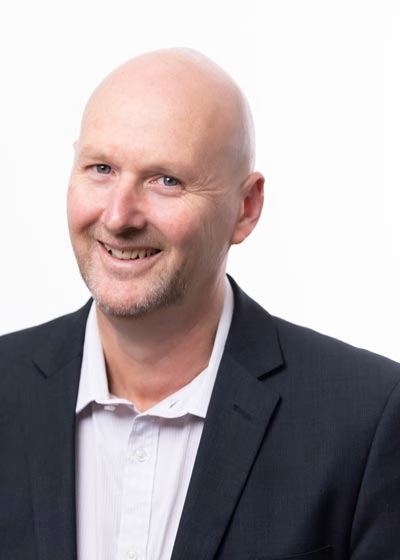
In this expert guest episode, we’re joined by Rob McDonald, better known as Safety Rob!
We talk about what happens when safety decisions become disconnected from the people actually doing the work. Rob has spent decades in workplace health and safety, including experiencing serious incidents himself, and argues that effective safety communication starts by getting away from the desk, asking better questions and listening to the people closest to the risk.
We explore why lagging indicators and traditional KPIs can give decision-makers an incomplete picture, why toolbox talks aren’t necessarily communication, and what needs to happen for important information to make its way from the frontline to the boardroom.
Because the role isn’t done until somebody does something with what you told them.
What You’ll Learn
- Why reporting what has already gone wrong isn’t enough to prevent what happens next
• Why managing from your desktop gives you an incomplete picture of the business
• What genuine two-way communication looks like
• Why a toolbox talk can easily become one-way communication
• Why important safety information can get lost on its way to decision-makers
• How photos, videos and frontline stories can make risks real for senior leaders
• Why asking people about problems without acting on what they tell you can undermine the whole process
About Rob McDonald
Rob McDonald is the Owner and Managing Director of GSD Safety, with more than 25 years’ experience as a workplace health and safety consultant. Through GSD Safety, Rob works with organisations to improve their safety management systems, protect their people and better understand the risks happening inside their businesses.
Worth Repeating
• “If you’re just reporting KPIs and traffic lights on that and how many injuries we’ve had, you’re not getting decisions to the decision-makers.”
• “I need a report process that says, ‘I’m dealing with this every day. I’ve talked to my team and through consultation, they’ve told me this, and we have these risks identified.’”
• “Take a photo of your highest risks. Actually get people just to video or say, or go and talk to people and ask them, ‘What is it you need? What is it you do that we shouldn’t be doing? What is it that can be improved?’”
• “The problem with a lagging indicator is we’re measuring ourselves against something that has already happened.”
Resources & Links
• GSD Safety: gsdsafety.com.au
• SafeAlign: safealign.com.au
• Influential Analyst Academy: blueboxdatastorytelling.com.au/iaa
• Email us: podcast@presentationboss.com.au
• The Presentation Boss Podcast: https://www.presentationboss.com.au/podcast
• Kate on LinkedIn: https://www.linkedin.com/in/data-storytelling
• Thomas on LinkedIn: https://www.linkedin.com/in/data-storytelling-au
About The Presentation Boss Podcast
Presentation skills for analysts, technical professionals and anyone whose ideas deserve to be taken seriously.
Every episode is designed to help you communicate complex ideas simply, influence decisions, and build confidence while presenting your work.
From data storytelling and slide design to strategic communication and presentation delivery, we break down what great communicators do and show you how to apply it.
Want To Become A More Influential Analyst?
The Influential Analyst Academy is our professional development community for analysts and technical professionals who want to communicate their thinking more effectively, have greater influence and advance their careers.
Transcript
Thomas: Strap in and safety first. It is episode nine of season two of the Presentation Boss Podcast, and I’m being funny because today we are chatting with Rob McDonald, or as everybody actually calls him, Safety Rob. He’s saved in my phone as Safety Rob. I actually had to Google his business to remember what his last name even was.
So we have him on the podcast today for our expert guest interview. K- Kate, tell us about our guest.
Kate: Yeah. We first met Safety Rob a couple of years ago at an event we went to. Mm-hmm. He has a business where he helps other businesses, large businesses, with their safety management systems. And I’m always attracted to people like Safety Rob because my background is in workplace health and safety as well.
So I, I loved to talk to him about safety reporting and, and all of that kind of thing. And we thought, for the podcast, who better to talk about safety reporting than Safety Rob? True. Yeah. Rob absolutely lives and breathes safety, as per his nickname. But he has so many really great stories, and we try to make for- make sure we focus on the communication elements of, of safety.
Thomas: I am so sure we could chat to Rob about communication and safety and all these types of things for literal hours.
Before we jump into the conversation with him, I’m gonna tell you quickly about the Influential Analyst Academy, which is the online community that Kate and I have built for technical professionals who are needing to do more with data in this age of AI, and learning the skills to communicate insights and to influence their team or the business.
We’ve always enjoyed working with safety teams and safety people. We have a bunch in there. So if you wanna get better at everything that happens around the analysis, like making strong recommendations, presenting, reporting upwards, and becoming a trusted advisor in your space, it’s something you probably wanna check out.
Each month we focus on a different skill that is going to help you. This month is all about data visualization best practice. There’s some charts in there that we’re having a, a good chat about. And every week we have some live session where you can have direct access to Kate and myself, ask questions, interact.
Look, I’ll drop a link in the description if you wanna have a little bit of a look.
Kate: All right. So let’s get into our chat with Rob. Let me tell you a bit about Safety Rob. Rob McDonald, the owner and managing director of GSD Safety, has over 25 years experience as a workplace health and safety consultant.
Throughout that time, he has developed both a passion and a skillset for protecting people, businesses, and reputations. Since founding GSD Safety in early 2022, Rob’s commitment to getting stuff done, GSD, has helped countless clients to sleep better at night knowing their businesses are safe and compliant.
Thomas: Let’s have a listen to our conversation with Safety Rob.
Welcome to the show, Rob McDonald. How are you doing, man?
Rob: Awesome. Thanks for having me
Thomas: Oh, so good. So good to have you on. I know you’re a busy guy. Um, look, we’ve, we’ve just heard your official bio, but really curious, can you tell us about Rob McDonald when, when he’s not at work?
Rob: Uh, married for about 23 years. I’ve got two kids, uh, my daughter Sophie and son Ethan. So Sophie’s turning 21 next week, and that’s a big milestone for her. Um, so she’s doing well, and she actually works for GSD Safety as well. Um, she’s part-time. So she’s, uh, also doing TAFE studies for library and, um, document resource management, so she’s excited about that.
She’s a systems administrator and my PA on three days a week, which is fantastic. Ethan is a first-year apprentice plumber, so he’s still learning to drive. So I’m up at, uh, 4:30 in the morning, and my wife, Belinda, she’s also up early.
She has a shower first, then I have a shower, and then I cook Ethan breakfast. And then I have to drive him around Sydney. And if you know Sydney, it’s not an easy spot to drive around, but at least at, uh, six o’clock in the morning, it’s not too bad.
But it’s getting back so I can go to work myself and then pick him up in the evening. So it’s, it’s a long day. Uh,
Kate: Yeah
Rob: we did have a dog, but unfortunately he passed away, so we only have one chicken left.
So that’s our pets at the moment.
Kate: Um, how close are you to him actually having his license and you not having to do the drive every day?
Rob: 14th of February and not counting.
Kate: Yeah, yep, yep.
Thomas: It’s not in the calendar at all
all right. Well, I’m curious then, Rob, uh, we know a little bit about you. Tell us about your work now. I see you’ve got your, your banner in the background, but tell us about your work now. Who do you help, and how did you get involved in workplace safety?
Rob: My goodness, 25 years of being in the industry. Well, now probably 30-odd years in the industry of safety. My background has been very vast and quite diverse across my lifetime. People say to me, “How many lives have you had?” You know, “How, how old are you and how many lives you had?” Because of the diversity that I’ve done.
So one of my original reasons for getting into safety and understanding safety as a risk and a process and, and needing to be done was I had two pretty bad accidents on drilling rigs. Um, it was surface and underground drilling on gold and various different operations. Uh, one I had a, um, 247-kilo rod, six-meter rod that we were using as a drilling rods.
So it was, uh… I was a runner. I was, I was, I was an off-siter on this particular day. I was a dr- I was a head driller, but on this day I was working a rig just to help out. And the clamshell in the back end of these 247-kilo rods, you run them down the length of the truck, and then you swing on them, and you go down and screw these pipes in, and it’s diamond drilling down.
And you could be drilling up to two kilometers down with these diamond rigs. And so these rods at six meters, they go up on a, on the hoist, on the, on the winch, and this was about two o’clock in the morning. The lights weren’t really good on the top of the rig and the winch, the big hydraulic winch bird nested, and the cable all became all tangled up.
It then started going in reverse, the cable, and it actually then dropped all the bird nest, sort of the weight of the rod came down. It came down between my legs. It bounced on the deck. It then flicked up and bounced across a rod box. It flicked up between my legs. I then was pivoted up and I was flying in the air like it was a seesaw motion.
I was then, uh, sort of like the heavy end. So I came crashing down. We then fell three and a half meters down to the dirt. The r- the rod was still between my legs. It speared into the ground about half a meter, and I’m on the ground and, and it basically is like… The driller thought he’d kill me. I was black and blue bruised for, for days.
The other accident I had was a, a jaw collapsed and on a breakout jaw, and tungsten carbide jaw, it collapsed and a piece went into my throat. Six months later, I’m in hospital getting a surgery done, and what happened was a piece of the metal was still in my throat. They thought it was cancer. They took it out and they go, “You’ve got a bit of metal.”
That was never accepted as a claim on the company. It cost me over 20 to nearly $30,000 on that surgery, emergency surgery, and I had to pay it myself. And I’ve gone, “Nobody needs to do that. Nobody needs to go through what I did.” So that was my safety background at the beginning when I was younger
Kate: That first incident, sounds like you were exceptionally lucky. That could easily have been fatal.
Rob: 100%.
Kate: Yeah. Wow
Rob: 100%. Yeah. Yeah. And, and, you know, it’s, it, it was a major thing that wasn’t actually looked after properly
Kate: Yep. Yep.
Rob: the investigation, the understanding, the whole lot
Kate: Yeah. Okay. So then, um, was something done about it after that, that you were
Rob: Yeah.
Kate: at all? Yeah
Rob: Yeah, yeah. Lighting got changed, the whole process, you know. Yeah. And, and, and it, it took a lot though for them to accept that it happened and what had happened and all the rest of it, because the investigation wasn’t done. The mine site wasn’t even informed Yeah. So there, there was a lot of stuff back then that people just buried
Kate: Yep. Yep
Rob: Because it’s the whole ramification idea about, you know, what are we communicating? How do we, how do we share knowledge? What are we learning from this? What are we doing about safety? Well, it’s all ramification. Oh, we get in trouble. That was what we were dealing with back then when I first started in safety.
Then I worked in various operations and various things over the years and it’s, it’s been a culture of old way and, oh, we don’t report stuff. We don’t have to talk about these things. And the problem with that is that nobody learned and nobody made decisions. So that’s c- two-way… effective two-way communication process that, that people really need to take on board now and do.
Because the problem with not feeding the right information up, decision-makers don’t make decisions
Kate: Mm, mm. Um, so this is, this is my world as well. Like, I came from a background of safety reporting. My first job was in safety, um, working in admin, and my job at the time, um, so I worked for an electrical company. My job at the time was the incident reports would come in on a form, um, a paper form. It was called a Form 160, and I would stamp the date on it, and then I would file it in an archive box under my desk, and that was our entire, like, safety management, um, system, I guess, was this like pile of paper that would get put in a box under my desk. Um,
Rob: Yeah
Kate: and I was in this team, you know, working support for a team that was really passionate because they had obviously had similar, um, experiences, maybe not directly themselves, but they’d, they’d seen and been around these significant incidents. Um, and they were… You know, it was the early 2000s. They were fighting to get recognized and getting safety to be, uh, getting, um, management to be interested in safety and, you know, it was a very high-risk environment that, um, these people were working in as well. Um, so why, why is it? Because, you know, you’ve had that incident, and these incidents have happened forever. Why is it so hard to get people interested in safety?
Rob: It, it’s always that, that legacy of, “We’ve screwed up. How do I own it without getting the blame for it?” That has always been the legacy of safety, and it’s a real big challenge. And you look at history of how it’s been managed. So management go, “Oh my goodness, you stuffed up.” And that creates a culture of going, “Well, why should I share anything?
Because it’s been… It’s then damaging to my career, or I don’t get believed, or it’s, there’s nothing gets done.” That’s the other side of things, that if I raise stuff, nothing gets done. Nobody does anything around here. Why should I blame stuff? Why should I raise things? Why should I talk about this?
Because nobody ever d- does anything around here. And that is a real concern, that legacy that still lingers in a lot of industries. And, and it is getting better. It certainly is. The education’s there, the, the knowledge is there, and people are changing in the, in the management systems and processes. But what’s happening is there’s still that legacy of blame.
You can say all the right things. We can say everything. But at the end of the day, how’s that culture being shared and not acknowledged? And what, what we look at is how the WH&S Act looks at this process. It’s, it doesn’t say about how, how we’re gonna discipline people outright. It says, “Ask them. Ask what’s going on.
Be inquisitive.” So one of the things that we need to have an understanding of communication is I want to understand. I wanna ask. I wanna be inquisitive about this stuff. I have an obligation. I, I, you know, I have a moral to do this correctly, and that moral should be driving that we look at communication correctly, and that two-way effective communication then drives from that.
And having, having a leadership role that says, “How do we manage this process for you?” Because safety costs a lot of money. It’s never in a budget. But at the end of the day, you still have to make the right decisions
Kate: Mm. It’s also difficult to make a compelling case for budget when the outcome is ultimately nothing. Like, a- as
Rob: Correct.
Kate: nothing
Rob: It’s a cost.
Kate: I mean?
Rob: Yeah, yeah, yeah. B- and, and this is the other oxymoron of safety. The better it is, you never hear about
Kate: Yes, yes
Rob: So why do we need it? It never happens to me. I’ve never had a problem with that. We don’t do that. We never see that. But what… That’s what risk is about. Like, we all talk about everyone has risk.
You, you get out of bed and you’ve got a risk, and you go across the road, you’ve got a risk. We all know it. But when, when it happens, it’s cost of your bottom line. It’s actually never, ever thought about until it happens. And that’s what communication should be about. Understanding the process of what people are going through.
Understanding that you can share up and say, “Look, boss, I’ve got this problem. I have to deal with this. I have to stick my finger in there. I have to do this. We do this day in, day out. I know a better way to do it, safer way to do it. Why do we have to put up with this broker?” All these conversations add up as to effective two-way communication processes, and the benefits are outweighing the process of somebody going, “Oh, I’ve gotta stick my hand up.”
Kate: And I guess that’s, yeah, that two-way conversation as well. Like, you’re competing against, um, against other people who are also, you know, potentially communicating really well about things that have a much more obvious commercial return. Um, so how do, how do you then, how do you get people to understand the significance of it when everything’s kind of a hypothetical?
Like, this could happen, this could happen. Like, yeah, but it hasn’t before, and
Rob: And,
Kate: know what I mean?
Rob: yeah, and that’s where it’s interesting. There’s enough information about this out there. And again, it’s about, about moral and inquisitiveness and understanding that you’ve gotta have the reduce- reduction of cost and, and sort of embedding the processes around safety is all program that must be done.
You’ll always be battling against that. If you talk to your team, if you talk to the management and you talk to all the levels… Uh, I, I often say, if you’re managing by desktop, you don’t know what’s happening.
Thomas: Hmm.
Rob: And, and that is really powerful too, because in that process, are you getting the right picture? Are you getting a- an understanding? We can talk about, you know, a walk in their shoes type process. It’s, it’s as similar to that process, but it’s also understanding what they’re dealing with. And when you start to open up those conversational points and, and start to have that two-way con- conversational point and not directing conversation, asking and being inquisitive about somebody, then you will understand more.
And they might have lots of things happening that you don’t know about. They might be personal, they might be physical, they might be process. You learn so much when you talk to people in the right way.
Thomas: So there’s so much value, isn’t there, in like for certainly that management level or that safety, um, reporter level of getting up from the desk, going having a chat to the people with their hands on the tools, right?
Rob: And, and, and that, that sounds easy.
Thomas: Mm.
Rob: It’s, it’s another piece to be consistent in your communication All too often we see in leadership, “I’m busy.” I know
for myself, you go back and you think about how … What is the best m- leader or manager you’ve ever had in your life? And how do you define that? And how do you think about that? And what is it that you go, “Okay, why is that the best person I’ve ever worked with?” And why is it they were a good leader? A lot of people say, “‘Cause they remember my name.
They know who I am.” That’s the most common answer I ever get when I ask that question. And why? Because it’s personable, it’s relatable, it’s inquisitive, it’s understanding me. I want to know Rob, I want to know Thomas, I want to know Kate.
Kate: That’s
Rob: And isn’t-
Kate: and my immediate response, like in my head was, they listen to me
Rob: Correct. So isn’t that powerful?
Kate: Mm.
Rob: Now, if you don’t do that in a period of time, it all becomes nothing, and that is the power of communication. Like friendship, you can pick up a friendship years later only because you’ve set that foundation. If you don’t set a foundation and a structure and a process with your team to understand them and get that knowledge from them, build that rapport, have a relationship, do the right thing by people, build that up, you will never have credit further forward.
And that’s a, that’s a powerful piece of communication too. So yeah, I can say, “Look, I’ve done a toolbox talk. I know my team. I go down and I talk to them,” and yeah, yeah, yeah, we d- we communicate to them all the time. What? We are doing a roadshow type style or you’re doing a toolbox? Guess what? Toolboxes are one t- one-sided talk.
People are gonna sit there, and how many times do you say and complain about your team sitting there going for half an hour, and you get nothing out of them? That is
Kate: We hear that all the time. Well, I used to hear that all the time. Like, toolbox talks are kind of pointless ’cause people just go, “Yep, yep, yep,” and they don’t listen anyway, and yeah
Thomas: Mm.
Rob: And guess what? I’m not on the floor and I haven’t just gone and done my job and people are gonna say I haven’t worked hard. Why, why… It’s a shift changeover. I- I’m 10 minutes late for them and blah, blah, blah. I’ve got everything else in my head going on. I’ve, I’ve… Well, uh, is the boss gonna chastise me over PPE again today?
Uh, we’ve been talking about bloody, you know, th- this or that or that, that’s actually not relevant to me because I actually do what I’m told to do all the time and blah, blah, blah, blah. All this goes on in your head. Then you’re expected to go, “Okay, I agreed to something. I’ve gotta say something.” And, uh, that’s it.
We’re all wrapped up, guys. Off you go. That’s not communication.
Thomas: Mm-hmm.
Rob: That’s not the point of a toolbox It’s a structured process. And I loved when I worked for a particular organization, they called it the war room. You walk into the war room at the beginning of your shift, and it was like we’re having a process-driven, like a going into a battle.
Guess what the commanders do? Guess what the military does? Guess what the process is? You have the hierarchy, yes. You have the leadership, yes. But they go in and strategize. They go in and talk about stuff. They talk about the front. They talk about the, what’s happening in the battle. They talk about the process.
What do the troops need? What do we need to do? How do we support them? Guess what? You’ve just put a structure in that people could communicate. If you go out in-into the, into the open area and you talk about a piece of paper that’s called the toolbox talk, because I’ve gotta go do this and I sound like this and I’m really boring, am I communicating to you or I just wasting your time and my time?
Thomas: Mm.
Rob: how do you do that personably when you go onto the process? So George is at the, at the piece of equipment that you’re working on. It could be a handheld piece of equipment, it might be a large piece of machinery, it could be a, a conveyor belt, it could be all sorts of stuff.
Could be anything. You walk up, and you understand that process. If you don’t understand that process, they do, and they will be happy to share stuff with you,
Thomas: Yeah
Rob: and you don’t have to look like you don’t know it. You just have to ask personal questions of how you’re going, what you’re doing, where we at, what can we help?
How long did that just take?
Thomas: Yeah, a few minutes, right? So
Rob: Great
Thomas: I’m gonna think about going the other direction here when it comes to safety reporting certainly upwards, and maybe, maybe the obvious answer is KPIs. Maybe it’s not, but like how do I work out what those above me, h- what management actually needs from me when it comes to safety reporting?
‘Cause, you know, conversations are great, but ultimately there’s gonna be reports and records made, right?
Rob: Yep, yep. And I, and I love you’ve gone KPI immediately in your thinking and your questioning there, ’cause it’s one of my bugbears.
Thomas: Ooh, okay.
Rob: I’m gonna be very controversial here.
Thomas: Great.
Rob: So KPIs, it was around about 50-odd years ago, bean counters went, “What does safety cost us?”
What is, what are, what are we measuring in safety? It’s the cost. When was the last time we hurt somebody When was the la– what was the last cost that are involved in this? Do you know when we hurt somebody? We’re talking about something really major happened. We’re talking about have we had that injury?
Not are we helping people in preventing injuries. KPIs are about lagging indicators. We all know about leading and lagging. So it’s a lagging indicator. The problem with a lagging indicator is we’re talk- we’re measuring ourselves against something that has already happened, and it’s really bad. So we’re gonna get challenged, and we’re gonna get our, our bonuses, and we’re gonna get our processes driven around how many times have we hurt somebody.
Now you’re thinking about, geez, why would we wanna measure ourselves against something that’s happened really bad? Why wouldn’t we be, be proactive and think about the processes of going, okay, what is the risks? How do we do consultation? And how do we communicate?
That’s a better m-m-management model and a better way of asking what’s happening in the business. The problem with KPIs is it’s already happened. What do we do about it? We go and fix that particular thing that happened. It doesn’t tell me what the risks are. It doesn’t tell me what is going to happen.
KPIs, people hang their hats on KPIs and say, “Oh, now we’ve fixed that. We won’t have that in the future.” How many times do you go into a business or how many times, Kate, when you did your reporting for a safety process, you’re doing the same reporting, the same thing over and over again?
Kate: Every month, yeah
Rob: Correct. And you’re injuring people the same way all the time.
So my answer to that, Thomas, is what do I need to share up? We have gone and done this risk review in this area. We have these identified risks. There’s a risk of this not working. There’s a risk of somebody putting their finger in this. There’s a risk in this process. We need to go and fix this. A KPI will tell…
not tell you what you need to go and fix. It will tell you what happened and what you’re gonna do to do that as an investigation. I need a c- report process that says, “I’m dealing with this every day. I’ve talked to my team and through consultation, and they’ve told me this, and we have these risks identified.”
Now, that’s actually needs to be communicated up
Kate: So to push back a little bit there,
Rob: Yeah
Kate: how do you, how do you tell though, without certain measures to actually measure certain things to measure, how do you tell if you’ve improved? One of my favorite stories, and I actually don’t know if it’s true, um, but one of my favorite stories is, like, after the Sydney Harbour Bridge was constructed, the team was, like, congratulated or given bonuses or something because they only killed 16 people. Is, is that actually a true story? Do you know?
Rob: Yeah, yeah. There’s… You look at major constructions around the world, and some of the things we celebrate and idolize and think are fantastic are full of dead people
Kate: Yeah, yeah, yeah. Um, so my point’s
Rob: To, to be blunt.
Kate: at the time 16 people dead in a construction project was considered an achievement. So, you know, there’s also that thought of like zero harm, of the only acceptable, the only achievement is zero. Which means then if you don’t know how you’re tracking, as soon as you’ve got one, you’ve ruined it. What’s the point of…
Rob: I ha– and I, it…
Kate: like, you’ve, you’ve got to have
Rob: Yeah
Kate: You’ve got to be able to track how
Rob: Mm-hmm.
Kate: performing
Rob: Yeah. But, but lagging shouldn’t be your celebratory process because this is a key piece too. And this is… I’ve mentioned that I’ve, you know, worked on mine sites and, and did that sort of process. So the, the, the biggest thing you see when you drive into a mine site, if you’ve never done it, one of the things is there’s a massive sign at the front that says, “We are celebrating 110 days of injury free.”
Woo-hoo. What happens on the 111th day when somebody gets hurt? Nobody gets a barbecue. Nobody gets a bonus. Is that a good measure? Is that a good work practice? Is that really gonna get people to report on the 111th day that we’ve just had an injury? Are we driving the right culture? Are we driving the right question set?
Are we driving the right promotion for our leadership to get it right? Because the, the higher up the chain you are, the bigger the bonus you get. And if we’re going to then say, “Well, was, was that a lost time, guys? Do we, do we really need to say that he went home after that? Could we get him back into the office for four hours?
Or could we stretch the figures ’cause it… Like, everyone wants a barbecue.”
And it, and it just, it frustrates me. It really does because everybody in the team then go, “I’m not gonna report stuff.” And it goes back to the whole process of the, the, the, the history of safety and that whole, “I’m gonna get in trouble.” Imagine the person goes and has an injury and they’re, they’ve just had to go and report it and everybody’s going, “Oh, geez, thanks.
We don’t get a barbecue. Oh, I’m getting my bonus review in three months’ time, and now we’re not gonna get it. Thanks-“
Kate: ‘Cause Kevin messed up with the forklift or whatever. Yeah.
Rob: Yep.
Kate: Um And, and yeah, I remember sitting in, in those meetings, um, and trying to work out do we log this as a LTI? Um, and you know, workers’ compensation is sitting there as well and, you know, we’re trying to work out how many hours was actually lost because, you know, that’s
Rob: Again, it’s a bean-counting process.
Kate: So, then, I mean, I still really believe that you’ve got to track performance, so let’s push then to
Rob: 100%. 100%, because you’ve gotta go back to stakeholders, you’ve gotta understand your costs in your business, you’ve gotta be able to do the right thing. I’m not saying don’t do it. I’m saying understand what communication needs to be done though and how you go forward with this. Yes, you’re gonna have injuries and accidents.
We’re all human. We make mistakes. We make brain fart ideas
Kate: that’s a controversial attitude in safety in general, isn’t it?
Rob: Yep
Kate: Of like accidents are going to happen. No, they’re not
Rob: I know, and we should be zero all the time.
Kate: Yeah
Rob: me any business that’s 100% zero, never in history. Show me how you’re gonna achieve it. You cannot because you have people. The only way you can do it is go and put in robots and guess what? You still need people and robots break down.
Kate: Yeah
Rob: they’re a laugh. Um, but i-i-in that you always need humans. You know, and, and yes, business is changing, our jobs are changing, but we all still need to do work and processes and we still need a living. We’re going to have injuries and whether it’s a minor one or a major one, I can’t tell you.
And it’s more important to do that than do lagging indicators like, “Oh, we’ve had a death, we’ve had an injury, we’ve had a near miss process.” They’re really not good reporting structures. I’m saying, yep, measure yourself. So you ask me, “Okay, how do you measure this stuff?”
Kate: Hmm.
Rob: My answer is, you ask somebody, they give you an answer.
“Do you have this policy?” Senior management will say, “Yeah, of course, we’ve got a policy.” Next, next level will say, “Yeah, we’ve got a policy. It’s in our G drive. It’s on the intranet.” The next, next will say, “Yeah, I’ve seen it. It’s on the wall.” The next layer down will go, “What the heck are you talking about?”
Guess who’s the ones getting hurt? The ones that go, “I don’t even know what you’re talking about.”
Kate: So then I guess the obvious, um, next step then is the lead KPIs then, the lead measures
Rob: 100%. So what I was saying is you ask somebody. So then you go and do some structural processes and reviews and you traffic light what the responses are by a, a group of people in the, in the business and get the same answer. And that’s a true traffic light by a, a cross-section of your business and you know you’ve got a gap.
I’d go and work on that gap. Then you come and review it again, and you ask the same question sets, and you ask the same group of people or, or another group of people and then go, “Okay, now we’re getting better because we, we understand our risks, we understand our people, culture and process.” We’re getting a picture of our business.
In that, that’s a much better way to do it than going, “I’m waiting for somebody to be hurt.” If you understand and they go, “Yep, I’ve seen that policy. Yep, it’s embedded. Yep, we do this.” Six months ago, we never knew it. We didn’t see it. We didn’t understand it. That is a measure. It’s a survey. It’s a review.
It’s an audit. Whatever you wanna call it, but you have to ask the right questions. And guess where those questions come from? The WH&S Act, the codes of practices, the regulations. They’re all there. All we do is go, “How do you apply it?” When you apply what your responsibility, your, uh, your obligations under the law, and if you break this down to go, “What are my obligations?
How do I measure my obligations? What am I doing to make sure I’m doing it right?” So the first thing the, the, the WH&S Act talks about is understand the risks in your business If you understand the risks in your business, you can’t hurt anybody ’cause you’re taking the risk away. If you, if you have… We go back to the analogy of everyone has risks in their life.
We go across a crosswalk, we go across a road. So what do we do? We put a set of traffic lights there. What do we do? We put a zebra crossing. But the risk is engineered out, ’cause we know the risk of crossing the road. So we put plans in place, and then we go back and look at it and go, “Did we do the right thing?”
Guess who we asked? The guys doing the doing. “Did we do the right thing? Uh, what are the results? Are we doing better?” Yeah. Why did we do better? ‘Cause we asked the right question, we put the right processes in place. It wasn’t because we’re waiting for a death. I hate it when councils go, “Oh, yeah, we’re not gonna put a set of traffic lights there ’cause we haven’t have had, had, uh, enough injuries.”
Thomas: So I’m curious then, I’m, I’m maybe taking a slight sidestep here, but as a team when a, is making some kind of recommendation to management, to the company, it’s not getting traction. do we work out as the, you know, the reporter I guess, whether the problem is in the, let’s say the recommendation, the evidence or how it’s being communicated?
How do, how do we work out where the problem might lie?
Rob: Yeah. And this is, this is a big one because when we, when we think about safety people in, in business, more often than not, I’m gonna be very generalistic here and not the exact… not, not, not the enterprise level. More often than not, safety works underneath HR or operations.
Thomas: Yeah
Rob: Safety is our number one obligation.
Safety is our number one. Safety is our highest priority. We hear all these terms, but the safety person reports under, under, under, generally three layers down from a CEO. One of the things then we hear is, “Okay, we need to actually go through these processes and, and, and understanding, and we need this reporting.
Once a month, we’ve gotta do all this board report back and blah, blah, blah, blah, blah.” What are we, what are we putting in there, guys? Lost time injury. That’s it. How do I make a decision on that? So I’m reporting through this person to this person to go to the board to through this person. And what are we reporting?
Lost time injury. And that then doesn’t get that reporting right. So the person that needs to be reporting and saying what they, they’re experiencing needs to be very proficient in getting that information across. If you haven’t got the right tools and the, and the process to do your job effectively and communicate effectively, the problem is going to be the story will not get to the decision-makers.
So it’s really difficult for people to be heard at lower down in the organization. So one of the things is safety is a criminal act.
Thomas: Yeah, well,
Rob: So that’s a key piece around how important safety is. Safety is often buried further down in the organization without being heard properly.
So one of the things that needs to be done is look at that process in your organization. The other thing is the to- the right tools to the person doing the job, so they can report the right things up. If you’re just reporting KPIs and traffic lights on that and how many injuries we’ve had, you’re not getting decisions to the decision-makers ’cause they only see the, that, and boards don’t have time to read reports, boards don’t have time to go through processes, so they need information very clearly and what needs to be done
Kate: So how do you go from being the safety person who sends us reports about KPIs to someone that decision-makers actually seek out?
Rob: That’s part of that inquisitive process It’s setting that relationship up, and that’s one of the things I had to do when I was, I was a younger person and in a lower role to get to where I was.
It took an incident, and I went in with a report that said, “I’m gonna tell you the truth. I’m gonna tell you what’s actually happening here. I’m not gonna fill this report in this template in and just tell you this is okay, or this is not okay, or bury the information.” I had to walk into the, into the CEO’s office, and the managing director’s office at the time, and say, “I’m gonna actually tell you what’s happening out there.”
And it’s not easy. There are ways to help. There is wa- tools out there to do it. But my biggest bugbear with the industry is safety software is all about lagging indicators.
Thomas: Fo- it sounds like it’s focused on building a report, telling management what they want to hear or so-called have to hear rather than something that really should be talked about. Th- uh, thinking here, if someone h- listening has to present safety information to senior management, say next week, next month, next quarter, what’s one thing you would tell them to do differently?
Rob: Take a photo of your highest risks Actually get people just to video or say, or go and talk to people and ask them, “What is it you need? What is it you do that we shouldn’t be doing? What is it that can be improved?” And guess where that’s gonna take you? It’s going to take you to that communication stage and that consultation phase, and then people can go, “Oh, I see it differently.”
If you go and actually say or bring somebody in to say s- a process, and it– and if you have the opportunity to say, “Okay, I want somebody to present what their day in the life of is.” One of the things I did when, when I was working for a major organization for Australia’s largest organization, I did a dialogue, the day in the life of.
In that process, I did a workflow and put footsteps, and it was daily, weekly, monthly, quarterly, yearly steps that we need to take. In that, I then also said, “What do we need to look at? What do we need to report? What is it that people are doing? What are the processes that people’s on their daily walk is?”
If you know what people’s daily walk is and what they’re doing as a function, you’ll have amazing understanding of your business
Thomas: It, um, leads me to a conclusion which is, I don’t know, maybe it’s crazy, but maybe it’s obvious, which is then safety reporting becomes about prevention and not reporting on what went wrong. I, I can fully appreciate the value of a quick video, which is, “Hi, I’m Kevin, the forklift driver. We have this pinch point in the corner that no one seems to care about. Can we fix it by doing AB- ABC?”
Rob: And, and all of a sudden you’ve got engagement.
Thomas: Mm.
Rob: And the, the culture shifts very, very quickly I find. We talk about culture, we talk about processes around, oh, the team don’t com- say stuff. If you do that simple process of going out to Kevin on the forklift… Poor Kevin, we picked on him today.
Thomas: Yeah.
Rob: Um, so in that process, you’ve just done three things.
What are your risks? I’m asking you. Now I’m gonna feed this back so we get a result. In that process, we’ve just engaged somebody in a conversation, and they’re going, “You asked me? Nobody asks me.” But the next step, Thomas, on that is: What are you gonna do about it? He’s just told you there’s a pinch point over in that corner, or there’s a risk of me driving around there and I’m gonna hit somebody.
What are you gonna do about it? Because it’s one thing is talking about it, the other thing is actioning it. That speaks volumes.
Kate: So, um, just conscious of time here, Rob. What is a book or a resource or something that has influenced the way that you communicate? How did you get to this point?
Rob: Frustration?
Thomas: I was, I was expecting him to
Rob: gives
Thomas: the, the, the, the act, like the health and safety laws. That’s what, that’s what he’s been reading.
Rob: It, it is my nighttime storytelling. Yes, Thomas. I, I didn’t wanna go straight there on saying, “Yes, it’s the act, it’s the, it’s, it’s the codes of practice and the regulations.” I, I, I, I certainly do read those and I do understand the process. I don’t think there’s anything specific that I’ve gone and read or taken as, uh, you know, the industry has delighted me in my knowledge on that.
I think what’s happened is that I’ve been frustrated and I’ve seen things happen, and I’ve had to look at ways to do something different. And it takes something special to do that. And I’m not saying I’m, I’m better than anybody else, or I’m not saying that, that my processes are always, you know, going to, gonna be the best.
What I’m saying is, how, how do we look at the process of saying, “What do we actually need to do?” Instead of doing the same thing and expecting a different result. And there was a somebody with a bigger brain than mine called Einstein that said that. And if we keep reporting the same thing and get the same results, and I asked you, Kate, did you do- get that with all your, your reporting as the admin person of safety, and you said yes.
Sometimes we’ve gotta think outside the square and go, “Why? What is it that we need to do that’s different?” And that’s what I’ve done
I hear a lot of consultants say, you know, “Oh, you’ve gotta read this book,” or, “You’ve gotta do this or follow this process.” I think it’s, uh, but it’s around the morals. It’s about the being inquisitive. It’s about cost control. It’s also about embedding. So embedding or being, um, executing processes.
Thomas: Yeah
Rob: And that’s what drove me, is the morals and obligations to get safety right
Thomas: It makes a lot of sense. You know, we do quite a bit of work with HR and safety teams as well, and they are always people, people. And that’s, that’s what we see with you, which is morals and ethics driven, not KPIs driven. I love that. Um, last question, Rob. If people wanna reach out to you, where can they find you?
Rob: The Google searches. That’s always a good thing. Uh, we are nationally footprinted, so we have offices around Australia and New Zealand.
Um, so yeah, the… Look up GSD Safety, look up SafeAline, those web pages. Uh, we do have a 1-300 number on our contact page that people can follow as well. We are in Bangaroo in Sydney as a main office. Um, so if you’re in Bangaroo, there’s really great coffee
Thomas: Look, thank you so much. We’ll put links to those, um, in the description here as well. But thank you so much, Rob, for a bit of time and your expertise on the podcast today
Rob: Fantastic. Thanks, guys.
Kate: Thanks, Rob
Thanks for being with us today. Head to presentationboss.com.au/podcast where you’ll find the links that we mentioned for the show from this great conversation with Safety Rob, and including links to the Influential Analyst Academy. If you know someone that you would love to hear on the show or if you have something of value to share yourself, please email us.
Get in touch at podcast@presentationboss.com.au. We hope you found value in today’s podcast, and we rely on you to share that around. If you found value in today’s episode, please recommend us or share it with a friend. And that’s it. Have a great week!