
S2E06. Nicky Jurd on Explaining Tech Without Making People Feel Dumb
53 minutes
Summary
It’s an easy trap to fall into. When you know your topic, and trying to explain that to someone who doesn’t. How do you do it without making them feel silly, overwhelmed or condescended to?
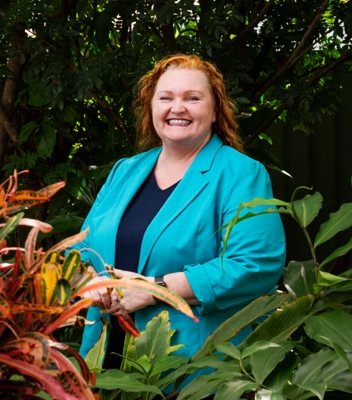
This week we’re joined by Nicky Jurd; digital strategist, business owner, self-described friendly and approachable geek, and quite possibly one of the nicest humans we know.
We talk about patience, jargon, audience interaction and building trust. Nicky shares practical ways to recognise when you’ve lost someone, why you should never take over someone’s mouse, and the seemingly harmless words that can accidentally make your audience feel stupid. We also wander into AI slop, $68 coffee, Simon Lancaster and, nudie swimming under waterfalls.
What You’ll Learn
- How to explain complex ideas simply without becoming condescending
- Why patience is a learned communication skill, even for experts
- How to recognise when your audience doesn’t understand, even if they’re nodding along
- The power of starting with foundations and building knowledge
- How asking the wrong kind of audience question can make people feel stupid
- How even simple jargon can sneak into our language and cause damage
- How trust comes from more than simply demonstrating expertise
- The important AI literacy skill that will make the biggest difference into the future
About Nicky Jurd
Nicky Jurd is a digital strategist, business owner and self-described “friendly and approachable geek” who has spent more than 25 years working at the intersection of business and technology.
She is a Director of Precedence, the Cairns-based web development and hosting company she co-founded with her partner Kaj in 2001. Since then, Precedence has grown from a small web design and SEO business into one of Far North Queensland’s leading digital firms, working across web development, hosting, custom software and digital strategy.
But Nicky’s real specialty is making technology make sense to people who don’t consider themselves particularly technical. As a speaker and trainer, she translates topics including AI, websites, digital tools, social media and online marketing into plain English and practical ideas that businesses can actually use. Her speaking clients have included Facebook, Bendigo Bank, Engineers Australia, the Queensland Government and the Australian Physiotherapy Association.
Public speaking has been a significant part of Nicky’s life for even longer than Precedence. She joined Toastmasters at just 16 and has spent more than 25 years developing her craft as a speaker, facilitator and communicator.
She was named Young Female Entrepreneur of the Year by the Cairns Business Women’s Club in 2014 and remains deeply involved in the Cairns business and technology community.
And, according to almost every bio ever written about her, all of this is fuelled by a fairly serious obsession with good coffee.
Worth Repeating
“My mum taught me how to use a spoon.”
“I try to be clear rather than condescending.”
“We’re giving a service that is complicated and technical, and if people knew it, they would never get to meet us.”
“Just usually means the speaker’s forgotten what it was like to not know.”
“Confusion shouldn’t be a character flaw. Confusion is an opportunity for me to empower someone and help them feel capable.”
Resources & Links
Nicky Jurd: nickyjurd.com
Precedence: precedence.com.au
Winning Minds: Secrets from the Language of Leadership by Simon Lancaster
Email us: podcast@presentationboss.com.au
The Presentation Boss Podcast: presentationboss.com.au/podcast
Kate on LinkedIn: linkedin.com/in/data-storytelling
Thomas on LinkedIn: linkedin.com/in/data-storytelling-au
About The Presentation Boss Podcast
Presentation skills for analysts, technical professionals and anyone whose ideas deserve to be taken seriously.
Every episode is designed to help you communicate complex ideas simply, influence decisions, and build confidence while presenting your work.
From data storytelling and slide design to strategic communication and presentation delivery, we break down what great communicators do and show you how to apply it.
Want To Become A More Influential Analyst?
The Influential Analyst Academy is our professional development community for analysts and technical professionals who want to communicate their thinking more effectively, have greater influence and advance their careers.
Transcript
Thomas: It’s episode six of season two of the Presentation Boss Podcast.
Kate: Hello.
Thomas: Today we have, we have a guest on to do an expert interview. We have Nicky Jurd, who one of the things I love most about Nicky is she may be the nicest, friendliest human on the planet.
Kate: Yeah. Agree. And one of the things I like most about our podcast is that it is a great excuse for us to just sit with someone that we really admire, um, that we really love talking to for an hour.
It’s just a, a great excuse to talk to cool people.
Thomas: Yeah. And look, the reason we got Nicky on is she has a, an unbelievable skill or talent or process to be able to explain cons- complex concepts to an audience without making them feel silly or stupid or like they’re being condescended to, which, you know, when you’ve got an audience who knows a whole bunch less in a topic than you do, can be quite a difficult skill to kind of master.
So we think it’s worth, uh, having the conversation with her to find out exactly how she does it. Um, before we hit record, and b- I’d say this, like, she is such a people person, kind of the opposite of, of me. Uh, as, as we talk about, before we jumped on, we kind of went on all sorts of tangents. She’s great to have a chat with, like you say, Kate.
Uh, we were talking about, like, the global sardine shortage and her upcoming trip to the Galapagos, just all sorts of topics, and eventually I had to be a little bit, “Let’s, let’s get on with the show and actually record a podcast,” right?
Kate: Yeah. I think she’s that beautiful intersection of, like, super expert and super people person.
That’s quite a unique combination.
Thomas: Yeah, coming from the, from the tech world. And we’ll learn about her business and how they help people with their technology, help people with websites, uh, and help sh- how she helps, uh, people in the community with their technology as well, and how, you know, when they don’t understand what’s going on, it’s frustrating, it’s difficult, it’s outside of their, their usual language, how she makes them feel empowered and communicated with.
It’s a really good 45-minute session, uh, with Nicky. Speaking of Kate- Yeah … how about we hear all about Nicky, and we’ll jump into the conversation.
Kate: All right. Her official bio: Nicky Jurd is a digital strategist, business owner, and self-described friendly and approachable geek, who has spent more than 25 years working at the intersection of business and technology.
She is a director of Precedence, a web development and hosting company she co-founded with her partner Kaj in 2001. Since then, Precedence has grown from a small web design and SEO business into one of Queensland’s leading digital firms, working across web development, hosting, custom software, and digital strategy.
But Nicky’s real specialty is making technology make sense to people who don’t consider themselves particularly technical. As a speaker and trainer, she translates topics including AI, websites, digital tools, social media, and online marketing into plain English, and practical ideas that businesses can actually use.
And according to almost every bio ever written about her, all of this is fueled by a fairly serious obsession with good coffee
Thomas: Let’s jump into the conversation with Nicky Jurd
Lovely. Welcome to the show, Nicky Jurd. H- how are you?
Nicky Jurd: I’m very well, thank you
Thomas: Nice, nice. Look, we, uh, we just heard your official bio. really curious. There was a, um, a thing that was not mentioned in the bio that I, I did read on your website about, like, you’re super into coffee. Like, I saw a $68 coffee, and you’ve judged the World Barista competitions. Like, what, what’s the coffee thing, man?
Nicky Jurd: I can’t even tell you how the coffee thing started. It was such a long time ago. Uh, I just really like coffee. I– Have you ever heard of a super taster?
Thomas: Yeah.
Nicky Jurd: I’m a super taster. So what that means in practical terms is I’m extremely bitter sensitive, and so grapefruit, beer, dark chocolate, they’re all safe for me.
I’ve never drunk a full beer. It’s so un-Australian to say that. I, I can barely even tolerate a sip, to be honest. Uh, and coffee is one of those things that is traditionally very bitter. So I’ve always sought out a more sweet and sour cup than a bitter cup, and they tend to be the fruitiest, most expensive cups of coffee.
So that’s why it’s sixty-eight bucks. You can get more expensive cups these days
Thomas: I, I’ve, I don’t think I’ve ever even spent $68, like, on dinner.
Kate: So there’s people who like coffee who are like, “Oh, you know, don’t talk to me before I’ve had my coffee. Um, you know, I can’t function without my coffee,” which I find, I don’t know what the word is. Um, and then there’s people who judge the World Barista Championships who actually, like, properly understand coffee. Possibly a dumb question: how do you tell that level? Like, how do you tell a good coffee from a good coffee at that level?
Nicky Jurd: Oh,
Kate: related to what we talk about, but I’m just fascinated
Nicky Jurd: Th-they are nuanced. So when you, when you judge WBC, um, the judging is all out of six and you’re face-to-face with a competitor for 15 minutes. And so you judge different parts of their competition. They deliver three beverages in, in 15 minutes. And some of the judging criteria is how they describe the coffee, and if you can pick up those same nuances in your cup, what you’re tasting, how it matches their description.
And the competition itself, it moves very quickly. You know, you’re not supposed to make the competitor nervous. You’re gonna make eye contact with them when they’re pr-presenting to you. And so many of these areas are weighted heavily afterwards. So when you judge out of six, there’s a weighting. Some have a multiplier of four, some have a multiplier of two.
So yes, often it’s, it’s just a tiny little nuance difference between what is the winner and what is the loser of that round. Tiny. And it could just be that they said caramel instead of chocolate
Thomas: I, uh, my, my, if I go out for a fancy coffee, it’s the push button one at like the 7-Eleven Servo that just…
Kate: Oh my God
Thomas: feel like we should move on from coffee as much as we probably could talk for the next hour.
Nicky Jurd: Actually, one of the best cups of coffee I’ve ever had is in Brisbane, Thomas. You should check out Coffee Anthology. It’s in the city. Go there and just have one nice cup of coffee
Kate: I know it’s on Adelaide Street. Yep
Thomas: I can appreciate a decent coffee. I stand by Brisbane coffee as equally as good as Melbourne coffee, if not better. So
Nicky Jurd: I do too. I’m with you on that
Thomas: Look, why don’t we move to, to some work stuff? I’m curious, Nicky, tell us about your work now. Who do you help? How did you get involved in it?
What’s the story?
Nicky Jurd: Hmm. I got involved a really long time. So I started my business back in 2001. It’s so long ago, I can’t really remember it that well. I was fresh out of university. These days, my company helps small business and organizations make sense of tech. So that might be building a website, maybe helping them improve their SEO or AEO, how to use AI, or just finding some much easier way of running their business.
So generally, we work under the auspices of building websites and building software, but in a practical sense, we’re very helpful in a tech perspective. I tend to do all of the front end of the business, so I liaise with clients and I liaise with my staff. So maybe I’m a translator between tech and normal humans
Kate: So my avatar for that, when I think about, like, people who are really good, um, they know what they’re doing, but they, you know, are hopeless with the tech side, I think of my avatar is my mom, who, you know, everyone’s had to set up a computer for their mom at some point. And it is difficult to have patience and to step through things quite simply. How do you actually explain and keep patient with those kinds of people? Um, is that something that you just, is just innate, or is that something that you’ve learned?
Nicky Jurd: It’s a learned skill. It’s definitely a learned skill. Uh, in my head I often say, “Bite your tongue. Bite your tongue.” I’m actually saying that to myself, “Bite your tongue. Hold on. Just let them finish. Hold on.” You see, once upon a time, I was teasing my mom about her lack of technical skill, and she turned to me very confidently and held up a spoon and said, “I taught you how to use a spoon.”
And I felt like that was the day I was put in my place. When patience was forced upon me, it was a really humbling moment, and ever since then, I’ve always been so much more patient with anybody who needs tech explained to them. So much so, actually, that last year I got a contract with the state library to teach tech to seniors, and it’s the number one bit of feedback I get from those sessions, is that I’m very patient with them.
See, many of our seniors, they’ve never had someone be patient with them from a tech perspective. Their kids, their grandies just do it for them and often don’t explain it in a way where they feel empowered and pick… can pick it up and be confident with it. So yes, my mom taught me how to use a spoon, and that was the day that I, I grew some patience
Kate: I cannot wait to use that line on my daughter. I am sure that, um,
Nicky Jurd: It will come up
Kate: Yeah, for sure. So, um, so how do you find the line then? When does simple become condescending or over- oversimplification? Like, where do you, how do you find that line?
Nicky Jurd: Uh, carefully. I think, uh, you know, in our culture, we have this ideology, sorry, Thomas, of mansplaining. You would have heard that term before, where somebody explains something to you that you already know very well. And for me, as an experienced presenter, it’s watching an audience reaction, see if they glaze over, see if they drop out on you.
Maybe someone looks away, maybe they look at their phone, maybe they s- cross their arms, something like that. You, you feel it if you lose them, and so I usually double-check. I’m checking in with them all the time about how I’m explaining things. And o- one trigger is if somebody says, “I know,” “Oh, yeah, I know that,” or something of that nature, that’s when I know I’m starting to cross the line to condescending and to check in and see what do they know, wh- where do I need to take this up or down?
Most often, I feel like I’m going too fast. I’m not being condescending. But again, I do teach a lot of people who say that tech isn’t their strength, and I try to be clear rather than condescending. At– When I first started my business, it was a time where our industry was very male-dominated and was driven by people who were very talented at tech, but not necessarily great at communication.
That has shifted over the years, but at the beginning it wasn’t that way. And so I felt like often people were trying to talk over my head, and I vowed that that’s not something that I would do to someone else. So it sort of come from that. It branched from wanting people to feel empowered rather than that condescending disempowerment, I’m losing you kind of feeling. And Thomas, that’s the most picking on guys I’ll do the whole session, I promise
Thomas: Oh, no, look, I get it. I, um, I’m very happy to ever be called out for mansplaining. I think it’s something that should be done. Which is like, like you said, like we need to be clear rather than condescending. I, I take zero offense at it if I I will apologize if I’ve over explained something. And I guess, you know, this is, this is interesting to me, which is how, how do you know or what do you do when you see that somebody maybe on the other side of that, they clearly just don’t understand, but maybe they’re nodding along and, and just saying, “Yep, I get it,” but you can kind of tell that they’re just trying to move this along and get away?
Nicky Jurd: Doesn’t happen to me that often, to be honest. Um, I feel like I’m very good at building a foundation and then incrementally growing on that foundation. I did have a session last month where I’d finished, um, two hours of tech speak with a s- a group of seniors, and at the very end, one of the fellas called me over and said, “Oh, Nicky, I’ve– I often go to websites and I, I wanna be able to type them in.
So I, I wanna go to realestate.com.au, but I don’t know here on the keyboard where the dot is. Can you show me?” And so I’d gotten to the end of a two-hour tech workshop, I’m like, “Oh, sometimes I need to be more simple or at least more encouraging to ask questions like that.” He was obviously afraid of asking that in front of everybody.
And, um, yeah, they’re the kind of humbling moments where I think, “Oh, you just don’t know what you know.” Yeah.
Thomas: We really got to start foundationally, hey?
Nicky Jurd: Yeah. I would never have thought that I need to explain where the dot is for a .com.au. Yeah. He went away happy though. He wanted to buy real estate. He was excited. “Oh, I can buy things online now.”
Kate: Yeah. Um, actually one of the reasons that we specifically wanted to get you on to talk about this kind of stuff was because I have heard you say in the past that one of your, like, life mission or, like, your rule is to not make someone feel dumb. Um, and that has been something that I have really tried to emulate, especially because every time my mum’s here she’s got some issue with her computer that I need to fix. Um, and I’ve tried so hard to not make her feel dumb, but I’m really curious to hear your perspective about that. And did that come from somewhere?
Nicky Jurd: Not really. I think, uh, when I first started speaking professionally, I decided that I should have a, a bit of a brand personality, and I’d heard that Jamie Oliver had one, so I went looking for his. And quite a lot of his brand personality I wanted to adopt. And y- if you’ve seen Jamie Oliver, you’d probably agree he’s fun, he’s practical, and he keeps things light-hearted.
And those three things I thought, “Oh, that really works well with tech.” And so in a sense I feel like that’s when I started to be a lot more conscious of what my delivery looked like, and that whole keeping it easy, making sure that people were confident when they walked out of one of my sessions, because mostly I’m being paid to do capacity building, so that’s really the outcome, is confidence and skills.
And so not making people feel, feel dumb really comes from the concept that I love audience interaction. I want them to interrupt me at any time and ask a question. I’m almost never in a situation where I’m delivering off the back of a set of slides and they have to follow the slides along. Usually I’m demonstrating things live.
And so if they feel too stupid to ask a question, I won’t get audience interaction out of them, and that means I’ve got to talk for two hours straight, and that’s really hard on your voice. So I love to get them to ask questions. I give them the option at the beginning. I say, “I’m really serious that I want you to interrupt me at any time.
It doesn’t have to be a question. It could be a comment.” It– Especially lately when we talk a lot about AI, I want to hear your thoughts about the ethics of the things that we discover today. And so I really want them not to feel stupid because otherwise they will close up and they won’t ask me questions, and then I have to do all the talking.
So it’s a little bit about trying to instill in them the confidence to say something. And usually right at the beginning when I tell them that they can interrupt, I prompt them to tell me what they want to get out of today or is there something that they came to learn. You know, I think you two also often have questions early in your, your training.
You, you want to really open people up and, uh, I wanna do the same. Yeah. I wanna get them to interact comfortably at the beginning so they’re okay jumping in at any time. There’s a couple of things I specifically don’t do and that I specifically do that’s in this space. So, um, I’m trying to think of what perhaps…
I, I guess going too fast is something I’m very conscious of, and starting in the middle is not a good spot for tech. It’s a good spot for story. So I’ll start foundationally, check in with people and build on that. Many speakers open with questions And if the question is something that has a, an objective answer like, um, what’s the capital of Ecuador?
You know, ev- it’s got an answer. It– there’s only one answer. There’s not two answers. Um, those ones get good interaction. People feel okay about it. But often a speaker will open with a question where they’re seeking a specific answer. And so it might be, um, “What do you think the best thing about Ecuador in the summer is?”
And in my mind, I’ve already got the answer, and I’m trying to get that answer out of the audience. And what that actually does is most people just feel dumb because they don’t know the answer. So they’ll either say nothing or they’ll say the wrong answer and then they’ll say nothing. So that’s a kind of situation that I’m actively trying to avoid, is trying to get an answer out of an audience where I’ve got the answer and it’s sub– it’s a subjective answer.
Typically, if I have an opinion I wanna share with them, I’ll share that opinion and then we’ll discuss it rather than trying to extract the subjective thing from them. A couple of other things is maybe if I ask a question, I don’t act surprised if they don’t know. If people give me the wrong question, I’ll gloss over the wrongness.
I’ll usually not even mention it. I’ll just talk about the right, um, the right answer. Uh, often I’ll have, particularly in the AI sessions, I’ll, I’ll often have a heckler these days, and it’s usually about water usage. I’ve had to do a lot of research about the water usage of data centers,
Thomas: All right
Nicky Jurd: uh, because it’s often in the environmental consequences of, of AI.
And sometimes that can be very disruptive, but they’re typically armed with incorrect info. And so trying to sideswipe away from that inf- incorrect info while still ha- keeping a conversation going in a respectful kind of a way, I reckon that’s my biggest challenge as a speaker right now. Yeah.
Kate: wow. I’m just sitting here racking my brain just thinking, “Oh, what kind of questions do I ask?” I’m really gonna have to, um, think about them and make sure that they are, that more objective correct answer kind of questions rather than hunting for the same opinion
Nicky Jurd: Hmm.
Kate: Oh, that’s really good.
I like that
Nicky Jurd: Yeah. Almost never will somebody know either. It, it sort of is a, a tricky thing to try and extract your opinion out of somebody else.
Kate: Mm-hmm.
Nicky Jurd: Um, yeah, I think that one’s probably my key one. I, I also do a lot of practical things in my workshop, so often they’ve brought their own laptop, they’re on their devices, something of that nature, and I’ve got activities for them to do.
And if someone struggles with the general controls of their device, I’m very conscious not to take it over. Sometimes they try to give it to me, and I’m really conscious not to take it over, that I instead instruct them. So I’ve also become quite good at instructing people. “Oh yeah, just go up there to the top left.”
And I really have to talk through the simpleness of running through those instructionals because people get muscle memory if they click in the right spots. Yeah. There, so there’s a couple of things. Um, hmm
Thomas: See, I quite like that. Like you say, you start super foundationally and, and build from there. And, uh, I mean, and my, my understanding is when you start speaking to an audience in that professional speaker sense, that y- you’ve always got this audience that’s thinking to themselves, like, “Prove to me that you know me.” And, you know, telling them how great you are, how much of an expert you are, how long you’ve been doing the thing, whatever, doesn’t help. It just kind of widens that gap between, “I don’t know what the heck’s going on as an audience,” and there’s an expert on stage. Like, using those questions to… And I’m, uh, I’m, I’m curious if you agree with this.
You use those questions to kind of gauge the audience or seek information for direction so that I, I don’t overexplain this, ’cause I can explain at any level, right?
Nicky Jurd: Yep. I often say to them, “I live, breathe, and sleep the internet, and sometimes I dream it too.” And so I’ll sometimes say something that you won’t understand. I really want you to interrupt me and ask for an explanation. That’s part of that same process is I, I don’t wanna just gloss over something accidentally like the dot on the keyboard.
Actually, I’ll probably never mention the dot on the keyboard ever at a workshop, but it was a moment. Yeah
Thomas: Yeah.
Kate: Wow.
Thomas: Also, I think as well, like, we- I’ve, I’ve seen you run large meetings, Nicky, and the amount of times I’ve seen you super calmly the same thing. It’s like, “You’re gonna be looking for a little microphone icon down the bottom left.” And I think I’ve seen you say that 50 times in a row, just the same patience to everybody, even though I’m sure in your mind you’re maybe getting a little bit, bit tired of it
Nicky Jurd: Actually, the only things really I can lose my patience over these days is if somebody is aggressively challenging my expertise repeatedly. Couple of times is all right, but if they’re telling me there’s no microphone, the microphone’s not here, there’s no microphone on my computer, that’s the kind of thing that I’ll get a little impatient over.
But that’s about it. Yeah, I don’t know how I became Switzerland. Definitely a learned skill
Kate: So then how do you bring someone back? Like, if someone misunderstood something or is just, like, not clicking, example, like, there’s no microphone Um, how do you use language that, again, makes them not feel Like, how it redirects them
Nicky Jurd: Yeah, redirects them. Usually I will redirect off the back as I’m– of I’m trying to help you. Not… I wouldn’t ne-necessarily say it like that, but, um, “Kate, let me help you find it. What can you see on your screen right now?” So I’ll ask them to try and describe something, a slight kind of interjection, and try to move their attention away from something that they seem a bit anxious about, and instead try to describe what you’re seeing, so then I can, I can help you.
Uh, s- also, there’s some known things that happen that just come with experience. Uh, an example is, um, sometimes they can’t find the microphone because they’ve minimized their Zoom window, and it’s sitting in this tiny little spot, and I have to try and get them, “Oh, that sounds like your Zoom window is really small.
We’ve got to make it big again.” And trying not to use the language of tech, like minimize is probably not right for somebody who’s a, a person who doesn’t know their computer that well. They just don’t know that kind of language. Sounds like it’s really small. We’ve got to make it big. Yeah.
Kate: of course. I wouldn’t even think about that kind of language of just, yeah, like minimize is often a tech word. Yeah
Nicky Jurd: Yeah. Knowing what the jargon is and what the everyday vernacular is, and switching it to the everyday version. I think that’s often something that I would do subtly Harder if I’m not in front of them, of course. Harder if we’re remote. Sorry, Thomas
Thomas: Yeah. Oh, no, it’s just… Like, what’s the result of that? Because I can imagine if you find, I mean, in this instance it is, you know, online meetings, but even if it’s your website or your business or the things you help people with, and it’s, it’s frustrating when you can’t make it work yourself, and then Nicky turns up, can explain it calmly, simply in language that doesn’t require experience.
Like, what’s the result of that? Do you find yourself becoming kind of the help desk? Which, I mean, like you said, you’re the client-facing person of the business, but-
Nicky Jurd: I get amazing Christmas presents, Thomas. Like, unsolicited, random stuff turns up at my desk. Uh, I have a couple of regular gigs, like, um, the library that’s across the road from my office, I have a, a monthly gig there. And December, I have this pile of Christmas presents. Uh, generally, attendees give really good feedback to the organizers, and so if they ever have to fill out some feedback forms, I get very glowing responses.
And honestly, it, it leads to me getting booked time and time again because of that patience. So I, I think it’s, it’s a unique thing in presenters that a, a tech presenter is patient with them and genuinely wants to train and teach them something rather than just get through the topic. So, so that’s what it is.
They turn into raving fans. Nobody’s got a Nicky tattoo yet. Maybe, maybe one day. They’re not the right demographic, honestly. Even small businesses don’t… Yeah. Uh, in our business, we tend to have people who are clients for a long time. I think our average client might be eight point two years right now. So we have very sticky long-term clients, and part of it is that empowerment in a space where there’s just not empowerment.
Once someone builds your website, they hand it over to you, that’s the end. Often there’s no training, and we have mandatory training included where we leave an hour and it typically takes only fifteen minutes. We also deliberately use tools that are very simple and easy for me- people to make changes to.
Not quite Google Sites easy, Thomas. I know you have an addiction. But it’s, it’s, it’s got some similarities to that i-in how simple it is to use. So I, I think that’s probably the, the great outcome is, yeah, raving fans. People really enjoy listening to me speak and enjoy having me back again
Kate: See, I will attest to that. So full disclosure, your company does, um, host all of our website, and you helped us set up our website. And so I’ve kind of had that first-hand experience of being walked through how to set things up. Um, and again, this is one of the reasons we wanted you on, because I felt like such a dummy, and the way that you walked through was, was so simple and, um, yeah, we’ve not…
We would never, for a long time, consider changing companies to use and build and help with our website every time, like, we send, um, or I send a, a please help. The communication back is just so lovely and patient and, um, yeah, I can attest to kind of what you’re saying as a, as a direct beneficia- beneficiary of it
Nicky Jurd: Oh, that’s so nice. That’s really good feedback to hear actually. Yeah, it i- it is a bit of a point of difference of the company, but we’ve always talked about how we, we are giving a service that is complicated and technical, and if people knew it, they would never get to meet us. Like we’d never… Yeah. I, I often try to help people when they say they apologize, “Oh, Nicky, I’m not very good at this tech thing.”
I’m like, “That’s okay. That’s why we exist.” Yeah. We’re here to help. So
Thomas: I say with full fondness, y- like your partner Kaj, who runs the back end of the business, the back end of tech, maybe the biggest nerd and technically brilliant person I know. I say that with, like, full kindness to Kaj. it, it feels to me as well, like, that patience, the empowerment, the explanation, the communication may be more important to having an audience understand something than being maybe the most technically brilliant organization on the planet, right?
Nicky Jurd: I think you’re probably right. Yes, Kaj is, um… I call him a genius every single day, and he’s very uncomfortable about this. I, I often say to him that you’re gonna change the world in some major way, and he’s like, “No, no, I just, I just look after websites,” kind of thing. He’s very humble about the whole thing.
But yes, he, he is our operations center, and him and I think and communicate very differently, and this has created interesting challenges in our business over the years. So Kaj thinks in spreadsheets, and I think in fireworks, and these two things don’t go together. They’re like sandpaper. And so if I tr- if I have a conversation, I have to try really hard to follow a list.
I jump all over the place, and then I’ll come back to it 20 minutes later. That’s how I like to think. Kaj doesn’t perform well in this circumstance. He performs well if we logically go through every nuance of a problem, and I don’t know, about three minutes in, I’m bored, and I need to move on. So this has created really interesting challenges, but, uh, I’m sure eventually we’ll figure out how to work best with each other.
He works in the upstairs office, and I work in the downstairs office. I interface with people, and he interfaces with computers, and it’s worked pretty well for 25 years, I’ve gotta say. But every now and then, we have to make a joint decision, and that joint decision will take 18 months. But every stone will not be left unturned.
Thomas: Mm-hmm. I think I relate to Kaj there ’cause I’m the spreadsheet thinker. Like, before we hit record on this, we’re having a chat and I’m, like, trying to go through my onboard checklist, and Nicky’s like, “Let me tell you about this other thing.” And then we changed topic, and I was just like, “Guys, we need to…” So I get it.
I get it. Um, but I think, uh, you know, like, like my favorite, uh, website platform is Google Sites ’cause it’s click and point and it’s super easy. Like, I’m not super technical, and when I look at even our business website, and I know you guys do much more technical stuff than that, it is just a black box. It is just, in my mind, like it is a mystery that I, you know, trust Kaj can run. Um, but it makes me feel like there is so much, especially when it comes to technical topics, there is so much trust there. Like, I just have to trust this, this company isn’t going to, you know, I don’t know, delete my data or sell my credit card or whatever it might be, right? It- it’s, you know, people are vulnerable. Is, is this all about in that front end about earning that trust of people so that you can kind of move on with the project and give it to the tech guys upstairs?
Nicky Jurd: Yeah. And I think in general, tech trust comes from expertise. Yeah. It’s something that is… I don’t know, it’s, it’s easily– It’s difficult to earn trust, but it’s easy to break it down. Um, and we have to be careful to do all the best practice stuff all of the time, and including like not even having typos on our own website happens.
We’re human. Yeah, I think we need to… You know, I once did jury duty, and a judge said it really well, is we don’t only need to be fair, we need to behave like we are fair. And I think about that in the concept of my own business is, we don’t need to just be trustworthy, we need to behave like we are trustworthy as well.
And, and that’s doing all the right things, like never asking you for your credit card over email, for example, or, uh, doing, you know, tech dodgy stuff ourselves. So I think, yeah, trust is tricky to earn in business. Once you got it though, I think people tend to be sticky. Yeah
Kate: I, I do wanna slightly push back on the, like, in tech expertise is trust because, um, I think it’s actually what you just said. You need more than expertise. You need to have the behaviors of trust as well. Um, there is a lot of tech people that I believe could do the job, but do I trust them to actually make the effort to understand what I’m trying to achieve and all of that kind of thing, um, is so much more than just expertise, which again, is, is why I appreciate Precedent’s, um-
Nicky Jurd: That’s the translation bit that I do. Thinking between what you’ve said and going, “I think they mean this.”
Kate: Yes. Yeah, the translation bit. Yeah, yeah, yeah, exactly. Exactly
Thomas: this longhand of saying Kaj couldn’t run his own business without you? Is that what we’re getting at here?
Nicky Jurd: Oh, no, Kaj would run a very, very good business without me. It would not interface with humans at all. I’m not even joking. So when I first met Kaj, uh, when we started our business, so we met and started our company within six months of the meeting each other. Uh, I reckon the first three years of our business life, he would not take a telephone call.
And even now, if he has to make a call, he will plan it. Like, Thomas, do you plan phone calls?
Thomas: Absolutely.
Nicky Jurd: “Oh, gosh. Okay, yeah. I, I didn’t know that was a thing. I just ring people and talk.” Even his mom, I caught him planning a call with his mom. So he’s really communication, uh, averse. Yeah. He, he doesn’t, he doesn’t love interfacing with other humans.
But it’s not that he doesn’t love communication, it’s that he is uncomfortable, anxious, and awkward in his own mind. Now, both of you have seen him speak at events. He is an absolutely brilliant speaker. His vocab is incredible. Uh, he’s, yeah, legitimately an amazing speaker, and I really look up to him for that.
But I’ll only hear a speech on stage from him once every couple of years Yeah, he’s really averse. It wouldn’t involve humans. It would be completely automated. He converted our 1930s Queenslander in a, into a home automation center. Like, we turn our car in the street and the roller door comes up. It’s like, it’s got all this crazy, awesome stuff
Thomas: Even more advanced. I just spent, like, a month upgrading my electric scooter, but that’s, that’s next level, Kaj. And I, y- you know, like you say, the planning the phone calls thing, like I, I… It’s why I love doing what we do, ’cause this is a learned skill. Like, if it was up to me, the lights would be off. I’d be here sitting here in my hoodie, like I wouldn’t speak to people.
I would sell to robots the same as Kaj would. I’d have my spreadsheets. But it’s, a learned skill, and s- I know so many technical people are the same, and Kaj, have brilliant stuff in their head. They’re gonna change the world, if only they can communicate it to e- everybody else. I totally, I totally get it
Nicky Jurd: Yeah. Yeah, I, I don’t understand it, but I appreciate that we’re both different, and I do like hanging out with people who think and behave different to me because otherwise I’m just in my own echo chamber and I’m never going to learn anything new. And he teaches me something new every day, even if it’s something that fundamental, uh, fundamentally disagrees with my character.
Yeah
Kate: I wanna say that’s a shame ’cause, like, there is nothing more that I want in this world than to be Kaj’s friend. Like, I have thought that so many times over the years.
Nicky Jurd: He would love to be your friend, but he’s not very good at communicating. Yeah. He’ll– It– Oh, as a really good example, so, uh, his dad texts him and he leaves them unread even if he’s read them so that he can reply. But his unread number of text messages is over 1,200,
Kate: Wow
Nicky Jurd: thinks he’ll get around to one day.
Kate: Yeah.
Nicky Jurd: Yeah.
Kate: Wow
Nicky Jurd: to, to really you gotta push it. Hmm
Kate: So to move on a little bit, Nicky, you’re kind of at the forefront of tech and, um, watching how things have happened. Obviously, the big conversation at the moment is AI. I’m curious what communication skills do you think people are going to need to develop, especially in the technical areas, um, in the next couple of years?
Nicky Jurd: I think we will need to be much better at analyzing than we are right now. I think that’s probably thing number one. Well, you know how grandparents needed to ride a horse to get around somewhere?
Kate: Mm.
Nicky Jurd: And Kate, your kids aren’t gonna need a driver’s license. They’re just gonna call up an auto Uber, you know.
They’ll, they’ll never need to learn to drive except for fun, just like we learned to ride horses for fun. So the tech is gonna shift so much that we don’t need to know things anymore. We can just call up knowledge. So the concept of having to look up in an encyclopedia, it– even just typing out something to find out that knowledge is gonna fall by the wayside.
So we don’t need to know stuff, but we’ll need to analyze stuff to still make good decisions. And that’s because the world will be much more AI driven than we are now. But AI has been trained on, well, the sum total of human knowledge, and I don’t know if you’ve seen it before, but there’s some people on the internet that’s wrong.
It’s been trained on that too.
Thomas: think I saw that guy once. Yeah.
Kate: Yeah, of course. I think, um, a- again, potentially dumb comment, but I think I didn’t think about AI being trained on all of those people as well. I just assumed that they are trained on, don’t know, this
Thomas: Google Scholar.
Kate: Yes. Thank you
Nicky Jurd: Yes. The, the objective stuff, not the subjective stuff. Yes. Mm. Uh, so yeah, when I think about that, it’s been trained on not just stuff that is, well, wrong, but also stuff that isn’t in my cultural opinion, things that I’ve not been exposed to before, ways of doing things. And so analyzing what AI gives us, I think that will become leagues more important than before.
Right now, we’re really sitting inside the space of AI slop. It’s really everywhere. People are finding it so easy to write stuff, to create stuff, and, uh, you’ve probably seen online a lot of pushback, particularly against AI marketing, how awful it is. And there’s been a big switch off from people. In fact, I, I saw just yesterday someone have a very angry conversation online about a local business using AI to put together just a menu.
It wasn’t even, you know, serious marketing. And they said they were never gonna support that business again because they were using AI. And I thought that’s a, a really angered response, but it had over two hundred comments of people who thought similar to that. And so this pushback, uh, you know, people being angry about using, using AI in business marketing, I find that very interesting that we’ve really quickly moved back to valuing a human’s touch.
And a human touch in marketing is easily leagues better than anything we see in AI right now. But, you know, AI’s the worst it’s ever gonna be today. It’s always gonna get better from here, and the marketing will get better. But that AI sloppiness, everyone’s using it everywhere with not a lot of, uh, discerning character applied to it.
So I think that’s the other thing that we will get better at, is using AI as an assistant that is invisible behind us rather than it’s obvious right now that we’re using AI. It will look, think, and sound a lot more like how we are. Yeah, I think those are the two big skills of the future, being better at using AI in an invisible manner, but analyzing the stuff that it’s giving us
Thomas: On the topic of scripting conversations, I’m gonna go back half and half a step here. You know, like I, I do, I do the sales for our company, and it’s, I would say scripted. It’s flowcharted, right? So I know what to say, when to say. You know, the, the worst time to think about what you’re gonna say is when you’re saying it, so it’s, it’s somewhat scripted and, and it depends on the personality type that’s in front of me or on the other end of the phone.
And there are some personality types that turn up having done the research. I get it, ’cause I’m that guy. I would research the absolute bananas out of something before I, I set foot in the shop or the website, right? And so when they come along, they go, “Yep, I’ve done some research. I think I know what I, I need.”
And, and I know they’re going to have some misconceptions, and that’s fine. We can compare notes. We can talk through it. Are y- I… Is this something maybe you’re finding or you see happening in the world that people have researched this now with AI more so than just a few Google searches, and arriving maybe more confident or with more misconceptions?
Is this a thing you see or, or walking through the front door of your business?
Nicky Jurd: Yeah, both sides actually. Yeah, both sides of that because AI is right now fundamentally a yes man. So whatever it is that your opinion is, it will follow that opinion down. It will help you argue that opinion. But it’s a little bit like you’ve probably used Dr. Google before, now it’s Dr. AI, but you don’t necessarily know the right questions to ask like a doctor knows.
And so it’s harder to arrive at the correct answer. And this is the same pe– along that line of misconceptions, people will start out with the misconception, then find all this stuff to justify it. But actually the question right at the beginning was the wrong question to ask anyhow, or is the wrong thing to think about.
We see it a bit in our industry when we make websites is people are very concerned about what it looks like and that tends to be everything in our first few meetings with them is what it looks like, how it will be laid out, how this is gonna work, how that’s gonna work. And my end goal is this is gonna bring you customers and those questions of how it’s going to bring you customers need to be built into the design questions at the beginning.
But people don’t think about that. They’re after color and texture and logo and stuff like that rather than usability. And so I need to focus on that usability and bring the questions in right at day dot. And right now we’ve got a fair, fair number of customers who bring to us a design concept that they’ve tinkered with on a– with AI, but they just never asked any business questions about how to arrive at that design.
It was all about how it looks
I don’t know if I answered your question that well, Thomas. It was a bit of a wander
Thomas: no, I like it. In, in my mind, I’m just thinking people come to you, the royal you, with what they want, and we have to balance that with what we understand that they need. And sometimes that’s a tricky explanation. I, yeah, I get it.
Nicky Jurd: It is
Thomas: Kate was thinking here too.
Kate: Mine is more of a selfish thing of like, “Oh gosh, have I done that? Have I like turned up with, um, here’s my ideas,” and haven’t thought about the, the full consequences of them? Probably,
Nicky Jurd: but that’s why we go to a professional and we can’t yet rely completely on AI, right? Our knowledge workers are dwindling to AI, but for the moment they’re not replaceable unless you know the right questions to ask anyway. Yeah.
Kate: True. Um, so in all of the conversations that you have, ’cause you talk to many, many people, is there any jargon or any phrase, if you could ban one thing, what would it be?
Nicky Jurd: Oh, maybe not me, but my team would love to ban Can You Make It Pop?
Or any other similar kind of thing where it doesn’t have a logical explanation. We can’t zero in on something and make it happen. If you said, “Can you change this from green to blue?” Easy. Yep, we know what green to blue is. We know what both those things are. But what pops for one person does not pop for another person, and so we need to dig into what is it for you that you mean doesn’t pop about this thing, and it’s just such a vacuous thing to try and discover is what, what does pop really mean?
Yep.
Thomas: That
Nicky Jurd: Yeah.
Thomas: is the sentence that I have banned between Kate and I is the w- sorry, not sentence, the word pop. I cannot stand the word pop. It is always dropped in as like a synonym for a better word. Like, “Let’s just pop down to the shops.” It’s like, you mean go or drive or walk or visit. You don’t mean pop.
Like, “Just pop your details in the form.” Fill out the form. I’m on a rant, I need to stop. I
Nicky Jurd: I’m glad I got you.
Yep. Can you make it pop?
Thomas: Yep. Yeah, look, um, I’m gonna also jump back another half step here. What’s something that a listener, somebody could change today or tomorrow that would immediately improve their ability to explain complicated ideas without making their audience feel silly or stupid?
Nicky Jurd: Hmm, get rid of the word just. It’s just over here, just configure this, just connect the API. Just usually means like the speaker’s forgotten what it was like to not know. So ditch the just. Obviously, obviously would be a close runner-up. So remove just and obviously from, from your vernacular, and things will flow.
People will feel better about what you’re saying. Just make somebody feel stupid. It’s similar to at the beginning of many events, a speaker will say, “For those who don’t know me.” It has that same sense of arrogance about it. Oh, you should just click here, or you should already know me. Yeah. So any of those words that they’re not overtly arrogant, but they come with the sense that you should have already known this
Thomas: Yeah. Love
Kate: But it’s tangible, it’s simple, it’s immediately implementable. Good. Yeah, good
Nicky Jurd: Yeah, no more justs. Just do this
Kate: Yep. Nice. Nicky, is there a book or a resource or something that has influenced the way that you present?
Nicky Jurd: Uh, no, there isn’t, but there’s one that I wish that had.
Kate: Oh yeah
Nicky Jurd: There’s a political writer in the UK, and he’s named Simon, and I don’t know his last name, but I’ve listened to a couple of his audiobooks, and he’s a beautiful writer. But also because his writing has always been for politicians, he’s a writer that speaks about capturing people’s hearts and minds, and I don’t feel like I’m there yet.
I don’t feel like I’m a good inspirational speaker. And he runs these, uh, face-to-face courses couple of times a year, and I’m determined to fly to the UK and go to one because I’ve, I’ve listened to two of his books now, and I really like him, and I wanna be better at that. I wanna dig into the hearts and minds of others.
I don’t suppose either of you have Googled to find out what his name is?
Kate: Not yet, but I will, yeah.
Thomas: Yeah.
Kate: Yeah
Thomas: a, we’ll put a link in the, in the podcast description. Um, and, and speaking of links for podcast description, Nicky, where can people find you if they’ve enjoyed this?
Nicky Jurd: Oh, Thomas, I wouldn’t be worth my salt if you couldn’t Google Nicky Jurd and find me
That’s what you should do. Jump onto Google. I hear even AI has heard of my name now. I asked it one day.
Thomas: like, can’t just ChatGPT that?
Nicky Jurd: Yeah, ask ChatGPT what I’m into. Hopefully it comes back with cool things, like work appropriate things
Thomas: Not the $68 coffee and the, the waterfall thing.
Nicky Jurd: Yep.
Thomas: Yeah, cool
Nicky Jurd: wonderful thing’s a good thing
Kate: So speaking of the waterfall thing, and we’re not letting you go without talking about the waterfall thing, because in the bio that you sent me, Nicky, it’s got some of your interests, and one of them was nudie swimming under waterfalls is a favorite weekend activity. Tell us about it. gotta, know
Nicky Jurd: Well, I live in Far North Queensland on one of the wettest places on Earth. Last year we got eight meters of rain, so there’s a lot of waterfalls.
Kate: Eight metres!?
Nicky Jurd: Yeah, eight meters. At my mother-in-law’s house, she got eight meters. It’s a lot of rain. The rain that we get for breakfast would wipe out most towns around the world.
It’s re- we get a significant amount of rain. So there’s always waterfalls, and Far North Queensland, probably not that well known out of here, but, uh, the beaches have stingers in the summer and crocodiles most of the year round. So that means that the beaches aren’t good places to go for swims, casual swims.
But the creeks are great, especially where there’s a waterfall, there’s not gonna be a croc there. And there’s just so many. They’re secluded. Yeah, some you have to hike in, and sometimes when you’ve been hiking, you don’t wanna get your shoes wet, you don’t wanna get your clothes wet, so you just chuck ’em off and jump under the waterfall and then shake dry off, and then get back on the hike and go out.
Last year for Christmas, I hiked into a waterfall and I was with my partner Kaj and my mother-in-law, and they went off to a different part and I’m like, “Oh well, there’s no one around. It’s Christmas Day. Nobody’s gonna come here.” So I got my kit off and had a nice little waterfall swim, about half an hour.
Then got my kit back on, went walking back. But my head torch failed, and so I was walking in the dark, and I was swarmed by thousands of fireflies that came into the phone, my phone, iPhone light. And so these thousands of fireflies swarmed in on me and then left again. It was really such a surreal experience that happened very quickly.
Even just telling you about it, I, I get, I get goosebumps. So waterfall swimming can lead to other cool experiences. I encourage you to be brave. Get your kit off at a, a waterfall, not one where people are likely to find you. I haven’t been sprung yet. Still early days, I suppose.
Kate: I love that. That was a surprisingly wholesome answer to one of the most interesting pieces of biography that I’ve ever read.
Nicky Jurd: Actually, there is something I wanna leave you with. With
Kate: Please
Nicky Jurd: the overarching idea of how I, I like to speak is that, um, I feel like confusion shouldn’t be a character flaw. I feel like confusion is an opportunity for me to empower someone and help them feel capable. So every time I sense, you know, that they’re not comfy with what they’re saying, I f- I think, “Oh, I can leave them feeling much more confident than what they came into this with.”
Thomas: Just beautiful. Amazing. I feel like, Kate, we could sit and chat with Nicky for, like, another hour, but, uh, we don’t… There’s- is there limited internet? There’s certainly limited time for recording. Uh, thank you very much, Nicky, for sharing your time, and knowledge, and experience with, with the Presentation Boss podcast.
Nicky Jurd: Thank you for having me. I’ve enjoyed it very much
Thomas: Amazing. Thank you
Kate: Thanks for being with us today.
Thomas: Head to presentationboss.com.au/podcast where you’ll find all the links from today’s show. If
Kate: you know someone that you’d love to hear from on the show, or if you have something of value to share, please feel free to email us, podcast@presentationboss.com.au.
Thomas: And we rely on you to share the information in this podcast.
If you found value in today’s discussion, please share it or recommend it to a friend. Have a great week.